Les Histoires à l’Étranger: Partie 1

Paris c’est une ville magnifique et grande, oui. Pourtant, quelles sont les chances de croiser deux fois la même personne? J’ai une petite histoire à partager d’un des jours les plus fous pendant mon expérience à l’étranger. 

Paris is a beautiful and big city, yes. However, what are the chances of seeing the same person twice? I have a little story to share from one of the craziest days during my experience abroad.

Ce jour était bizarre depuis le début. Mon colocataire à Paris (et une de mes meilleures amies de NY), Amanda, est venue avec moi prendre des crêpes à Princess Crêpe après nos cours. Avec deux autres, nous avons mangé certaines des meilleures crêpes. Malgré le fait qu’Amanda a fait tomber une partie de sa crêpe par terre, tout s’est bien passé. 

This day was weird from the start. My roommate in Paris (and one of my best friends in NY), Amanda, came with me to have crepes at Princess Crêpe after our classes. Along with two others, we ate some of the best crepes. Despite the fact that Amanda dropped part of her crepe on the floor, everything was going well. 

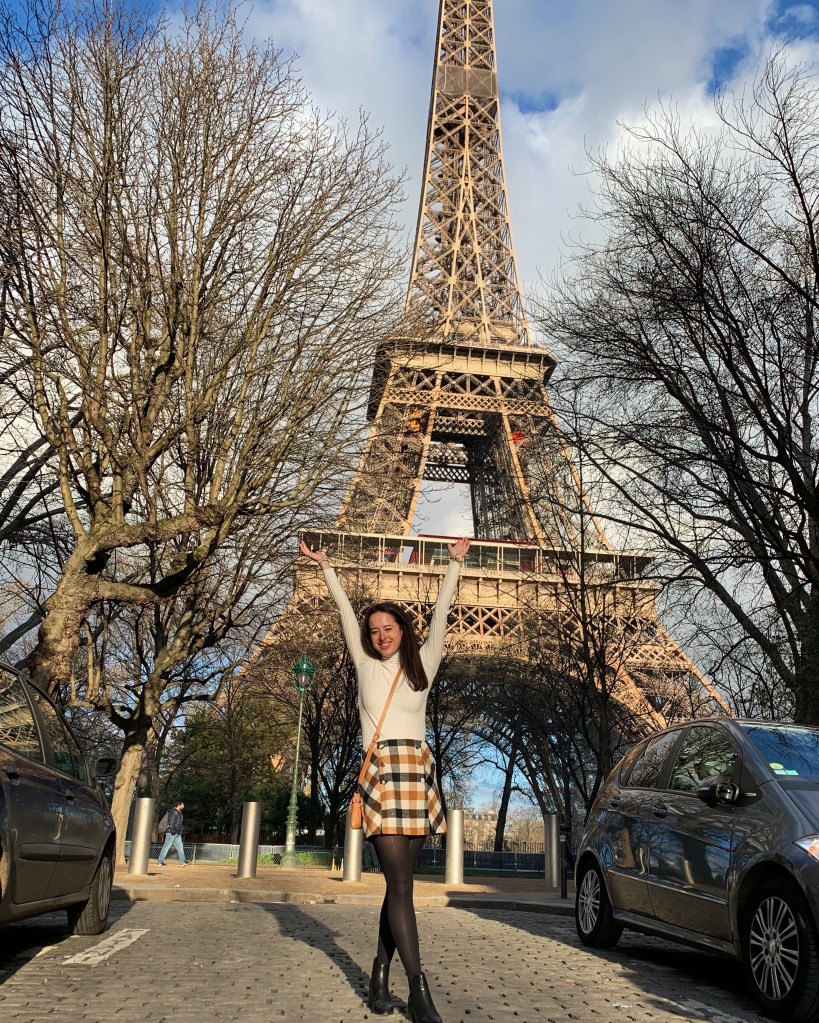
Nous sommes allés toutes les quatre à la tour Eiffel où on a vu des joueurs de foot, comme j’ai dit tout s’est bien passé. Plus tard, les deux autres sont partis et Amanda et moi avons voulu aller au Centre Pompidou. C’était la première fois à Paris quand j’ai appris à ne pas avoir confiance dans les directions de Amanda. Après une heure et demie, en suivant elle, on est descendu du train…mais je n’ai pas vu le Centre Pompidou devant moi. Plutôt, on était à Georges Pompidou, le lieu à l’extérieur de Paris.  Pour plus de cette expérience on peut regarder mon YouTube vidéo ici: (Georges Pompidou est à 1:11 dans cette vidéo). 

The four of us went to the Eiffel Tower where we saw soccer players, as I said, everything was going well. Later, the other two left and Amanda and I wanted to go to the Pompidou Center. It was the first time in Paris when I learned not to trust Amanda’s directions. After an hour and a half, following her, we got off the train… but I did not see the Pompidou Center in front of me. Rather, we were at Georges Pompidou, an area outside of Paris. For more of this experience you can watch my YouTube video here: (Georges Pompidou is at 1:11 in this video). 

Sur le retour, on a pensé d’arrêter à Ikea. Nous avons marché dedans et avons décidé d’utiliser les toilettes (à cause du trop long voyage mdr). Ensemble dans la stalle, Amanda a accidentellement appuyé sur le bouton d’appel d’urgence sans savoir. Quelques instants plus tard, nous avons entendu la voix d’un homme qui nous a crié en français. Avec aucune idée de ce qu’il a dit, nous avons répondu avec la peur dans nos voix “Un moment!!” (Looking back on it, this was hilarious). Après être sorties de la toilette nous avons fait du shopping et avons continué sur la route chez nous. 

On the way back, we stopped at Ikea. We walked in and decided to use the toilet (due to the long trip). Together in the stall, Amanda accidentally pressed the emergency call button without knowing. Moments later, we heard the voice of a man shouting at us in French. With no idea what he was saying, we responded with fear in our voices “One moment !!” (Looking back on it, this was hilarious). After getting out of the bathroom we went shopping and then continued on the road home. 

Je pense que c’était vers 19h00 quand nous sommes arrivées à notre appartement, plein de fatigue. J’ai commencé à faire la cuisine (des pâtes bien sûr). Moins de cinq minutes plus tard, j’ai reçu un texto d’une fille de notre programme, qui a acheté un billet pour un événement auquel elle pensait que nous allions. Oublie les pâtes! 

I think it was around 7:00 p.m. when we arrived at our apartment, exhausted. I started to cook (pasta of course). Less than five minutes later, I got a text from a girl in our program, who bought a ticket to an event she thought we were going to. Forget the pasta! 

Amanda et moi nous sommes préparées et nous sommes sorties avec une vitesse incroyable. En achetant nos billets dans le métro, nous sommes arrivées à l’heure à l’événement Erasmus. Si vous ne le connaissez pas, Erasmus est une organisation qui connecte les gens et étudiants internationaux. Ce soir, Erasmus nous prendrait aux bars et boîtes de nuit à Paris, avec un guide pour nous montrer le chemin. Nous avons passé presque une heure à chaque endroit, et enfin on est arrivé à O’Sullivans à Pigalle. Après avoir fait la queue pour entrer, nous sommes entrées et avons immédiatement vu quelqu’un que nous connaissions: Jon Du. 

Amanda and I got ready and left with incredible speed. Purchasing our tickets on the metro, we arrived right on time for the Erasmus event. If you don’t know, Erasmus is an organization that connects international people and students. This night, Erasmus would take us to bars and nightclubs in Paris, with a guide to show us the way. We spent almost an hour at each location, and finally we arrived at O’Sullivans in Pigalle. After waiting in line to enter, we walked in and immediately saw someone we knew: Jon Du. 

Jon Du est un chanteur français. Nous l’avions rencontré quelques semaines auparavant après son concert à Supersonic. Et cette nuit, dans un endroit totalement nouveau, nous l’avions revu. Trop bizarre mais également trop cool, la coïncidence c’était dingue. Cette nuit Amanda et moi avons rencontré Margaux, qui aujourd’hui est une de mes meilleures amies françaises. Jon Du nous a présenté à des gens et il s’est assuré qu’on passe une bonne soirée. Le reste de la nuit a été super amusant et nous sommes finalement rentrés chez nous et nous nous sommes endormies après une si longue journée de folie. 

Jon Du is a French singer. We had met him a few weeks prior after his concert at Supersonic. And that night, in a totally new place, we saw him again. It was so weird but also so cool, the coincidence was crazy. That night Amanda and I also met Margaux, who today is one of my good French friends. Jon Du introduced us to some people and made sure we had a good evening. The rest of the night was super fun and we finally got home and fell asleep after such a long crazy day. 

Tenez moi au courant si vous souhaitez lire plus d’histoires comme celle-ci. Paris me manque! 

Keep me posted if you want to read more stories like this. I miss Paris! 

À bientôt:)

True or False: My American Friends Share Their Stereotypes of the French

Salut à tous! Ça fait longtemps que je n’ai pas écrit sur ce blog, mais je suis revenue! 

Hi everyone! It’s been a long time since I last wrote on this blog, but I’m back!

J’espère que tout le monde va bien. Aujourd’hui, je veux parler des stéréotypes des françaises et partager mes expériences avec eux. D’avoir les meilleurs résultats, j’ai demandé à mes amis américains quels sont les plus grands stéréotypes dans leurs opinions.  

I hope everyone is doing well. Today, I want to talk about some stereotypes of French people, and share my experiences with them. To have the best results, I asked some of my American friends what they think are the biggest stereotypes of the French. 

À cause d’avoir un public principalement américain, j’écrirai en anglais pour le reste de ça (et de ne pas faire de fautes). Merci à Jacob, Tyra, Jade, Sara, Amanda, Audrey, Kaelyn, Will, Joe, Stephanie, Alicia, Alanna pour les réponses. C’est parti:)

Because of my primarily American audience, I will write the rest of this in English. Thanks to my friends for the responses. Let’s begin:)

  1. The French are rude. 

As mentioned in some of my other posts, the French are definitely straight-up people; they like to tell it how it is. For Americans who are super bubbly and personable, often French people seem rude because they don’t sugarcoat as much. They also have really bad customer service, any American expat article or video can tell you that. However, at least in my own personal experience (as most of this post will be speaking from), I do not consider them to be rude, instead I think it’s just a cultural difference. Therefore, I would say this stereotype is false. 

  1. The French all smoke. 

This stereotype is somewhat true. Certainly, a lot of people smoke in France. According to the CDC, about 14% of American adults smoke, whereas this number is about 50% in France. It is looked upon less negatively than in the U.S., and you can typically smoke outside at cafés (je pense que c’est plutôt normal). However, none of my three closest French friends smoke, which leads me to say that this stereotype is only somewhat true (c’est pas obligatoire pour tous les français mdr).  

  1. The French are skinny. 

This is another that I would say is somewhat true. I think what this stereotype is really getting at is the idea that French portion sizes are smaller, which is definitely true. In general Americans tend to overeat and we love to have an abundance of everything. This was shown to me the first time I ever walked into a French grocery store, where you will not find 50 different cereals and types of pasta as you do in the U.S. The tendency to eat smaller portions is what leads Americans to think all French people are skinny, however I do think you see all different body types in France, too. But, the stereotype is true in that obesity is much less of an issue. 

  1. The French are fashionable. 

While I am not super familiar with the entirety of France, I can agree it is true that Parisians are fashionable. I love the black chic color scheme which can be seen here. It’s a more formal and stylish look that could probably be described as posh. Yet, stereotypes are stereotypes and usually don’t apply to absolutely everyone, and I would add that the rest of France is not Paris, so it’s likely not the same. 

  1. The French are romantic. 

This one is hard for me to fully comment on. If you follow Anna Kloots (who was talked about in my expat blog post) you would know she is currently dating a French man (son voisin!). She makes him out to be the most romantic man in the world, giving her gifts every day and taking her on weekend trips. However, in general I think it depends on the person just as it does in the U.S. Perhaps the fact that Paris is known as “the city of love” contributes to this stereotype. Feel free to read more about French romance in my previous post, and share your opinions below. As for now, I think I would say I am unsure, or as comedian Paul Taylor loves to say, ça dépend!

  1. The French smell bad. 

This stereotype is absolutely false. I was told by one of my favorite French teachers that this stereotype came to be from the early days of Louis XIV, who, spectated by hundreds of nobles daily, was only ever seen showering a few times. I’ve also read that this comes from the knowledge that French people use less air conditioning (and therefore maybe sweat more), or because their diets consist of strong cheeses that have distinct smells. Yet, even while some of these points may be true I have never met a French person who smells bad.

  1. The French eat baguettes every day. 

I know… a dream. If you knew me when I was an early teenager, you would know I would eat full baguettes on the daily. Since then my ways have changed (somewhat), but studying abroad in Paris last spring tempted the old habits. Les boulangeries were always full of Parisians waiting to get their various baguettes. While unlike young me, I am sure most French people don’t eat full baguettes on the regular, but bread is definitely integral to their meals and daily living, and therefore I would say this is somewhat true. Their baguettes are really good, but also on a separate note of bread I would recommend buying a loaf of brioche from the grocery store (aux pepites de chocolat). This type of bread is amazing!! (And worth a trip to France on its own).

  1. The French think they are the best. 

As most of these have been, this one is probably also somewhat true. I think they can definitely acknowledge when other countries do things better or more efficiently, but from what I’ve read, watched and experienced, they do have a bit of chauvinism. Yet in their defense, is that really a bad thing? Ideally, Americans would have that pride, too. I do have to say that one thing they are absolutely the best at is debating, and don’t even try to debate that with a French person… you’ll lose. 

  1. The French like techno music. 

This is another stereotype that I have mixed feelings on, but overall I’d yet again use somewhat true. While everyone has different music preferences, I certainly found from my time abroad that going out in France (notamment aux boîtes de nuit), techno music is always played, which is not so common here in the U.S. I had that same experience in Germany, too, so I would guess it is a European cultural thing as opposed to the often pop American music played here. 

  1. The French are intellectuals. 

I would lean more towards true for this stereotype, especially considering philosophy is a curriculum requirement for students before college. I also think the culture contributes to their deeper knowledge. At least out of my own experience, the French people I know are deep thinkers and very intelligent, which is why I’d confirm that they are intellectuals. 

As I mentioned earlier, these are just my reactions to the French stereotypes that my friends shared!

Are there any other stereotypes of French people you know of or believe? Feel free to share or let me know if you agree/disagree with any of the ones above:) À bientot!

For more reading, check out this article on French stereotypes:

https://www.expatica.com/fr/moving/about/french-stereotypes-740737/

Is French a Romance Language or Romantic Language?

Well there’s no difference, right? Wrong.

When we think of romance languages, French, Spanish, and Italian typically come to our minds. Recently, I’ve been curious as to what makes a language a romance language, so I decided to do some research into the subject. To my surprise, the romance languages were not named that because they sound attractive, but instead because of their connections to Latin. 

All of the romance languages have been derived from vulgar Latin, creating many similarities between their vocabularies and grammatical structures. This makes learning multiple romance languages easier, because there are some commonalities. For example, my friend Seb who was born in Italy and had lived in Spain for two years came to the U.S. where he learned English. In high school, we were in the same French class and he picked it up so easily, which he would say was because it was similar to Italian and Spanish. For me, learning French was harder as all I had to compare it to was English, a Germanic language. On the other hand, Seb could almost always guess the meaning of words because of how closely connected the romance languages are. 

Back in the days of the Roman Empire, Latin was the spoken language. The Roman word romanice refers to vernacular Latin, or the everyday spoken Latin. During medieval times, less formal writing was done in this vernacular way, familiar to the public in their everyday lives. With that said, the word romance became associated with these written stories, which were usually stories of knights and other exciting adventures. As time passed, these stories began to involve more romantic ideas, leading to our modern understanding of the word romance to be related to love. The idea of romance equivocating to stories can be traced to today, as the word roman in French means “novel” in English. For a much more historical description on the origins of romance languages, you can check out Britannica’s page here

Yet, regardless of the connection of the word romance to romantic novels and stories, the name “romance languages” has nothing to do with attractiveness. So, what makes French, a romance language, also a romantic language?

French is often considered one of the most romantic languages. While a lot of this is based on opinion, here are some theories as to why French has become widely known to be romantic:

  1. The Spoken Rhythm: 

The pace of the French language is why many think the language is so romantic, as it has a sort of euphonic flow, meaning it is appealing to the ear. This speed and rhythm is one reason why many people think French is pleasing to hear and attractive. 

  1. The “City of Love”:

The stereotype of Paris in modern pop culture has led people to believe that France is a country full of lights, love, and the prettiest views. While I am not saying these things are not true, the association has led foreigners to extensively believe that France is a romantic country, and thus, that the language is romantic. 

  1. The Pronunciation:

As for pronunciation, most of the ending consonants are not pronounced. As my mom always says it sounds like there is no separation between words. Some people believe this continuation of the words is another reason the language becomes romantic, going back to the idea of euphony.  

Other cultural aspects contribute to the idea of French people as being romantics, which additionally associates the concept of romance with the language, too. Whether you agree or not, studies have shown that French language is viewed romantically, in addition to being a romance language. 

What are your thoughts, is French a romance language, a romantic language, or both? 

Another Source for More Information: 

The French You Don’t Learn in School: Verlan

Even after studying French for nine years, it was only until the last year or two that I heard of Verlan. Verlan is a type of French slang (argot), coming from the inversion of syllables in the French language. The word Verlan comes from à l’envers, which in French means “the wrong way/inverse.” Verlan when broken by syllables is vers-l’en, again showing its origination from l’envers (the “s” sound is silent). While I am definitely not an expert in this type of slang, it is so interesting to have to decode the words and to hear how useful they are in typical conversations. If you want to learn more Verlan you can definitely find so many resources online and on Youtube. 

Verlan began during the time of Voltaire, as well as during WW2 as a secretive language for the French to utilize against their enemies. It started to become popular in poorer neighborhoods of Paris in the 1960s. In 1977, a song “Laisse Béton” was released. The phrase laisse béton, although not used very much anymore, is Verlan for the well-known phrase laisse tomber, meaning let it be. Not every word has a Verlanized slang word, but many everyday words do. Today, Verlan is extremely common and is found in pop culture in many shows, films, and music. For example, the popular singer Stromae’s name is Verlan, from the word maestro. My understanding is that today Verlan is most popular in oral conversations with younger generations (especially teenagers), but you certainly hear and see many of these words all of the time, so it is useful for everyone to know. With that said, below I will share some of the Verlan words that I have learned. Feel free to comment if you know any others:) 

  • ouf: from the word “fou”, meaning crazy

Example: Le concert était vraiment ouf, j’adore ses chansons. The concert was really crazy, I love his/her songs.

  • cimer: from the word “merci”, meaning thank you
  • meuf: from the word “femme”, meaning woman/girl

Example: J’ai un rdv avec une meuf. I have a rdv (rendez-vous/meeting) with a girl.

  • chelou: from the word “louche”, meaning sketchy or weird

Example: Mon meilleur ami ne me parle pas du tout ce mois-ci, c’est chelou. My best friend didn’t talk to me at all this month, it’s sketchy/weird/shady.

  • relou: from the word “lourd”, meaning heavy (as in a lot on your shoulders, not physical weight)

Example: Elle l’a trompé, trop relou l’histoire qu’il m’a dit aujourd’hui.

  • vénère: from the word “énervé”, meaning angry

Example: On est vénère que le prof ne fasse rien. 

  • keuf: from the word “flic”, meaning cop

Example: Attends, je vois les keufs, ralentis! Wait, I see the cops, slow down!

(Apparently keuf was becoming too common in France, and even police started to catch on to this slang, so the word has been re-Verlanized again and you may here “feuk” as an alternative).

  • téma: from the word “mater”, meaning to watch/look

Example: Téma, c’est sur la télé. Look, it’s on the TV.

  • tromé: from the word “Metro”
  • reuf: from the word “frère”, meaning brother 

Example: Lui, c’est mon reuf. Him, that’s my brother.

  • reum: from the word “mère”, meaning mother
  • reup: from the word “père”, meaning father
  • teuf: from the word “fête”, meaning party

Example: Y a un teuf ce soir chez eux? Is there a party at their house tonight?

Why My 2020 Spotify Wrapped was Entirely French

Before I even begin I want to say that I can’t even believe I have 20 subscribers on this blog… crazy! Whether you are following along because you are actually interested in the content, or if you subscribed just to support me, thank you!! I even have an actual French subscriber, so now there’s really no kidding around:)

About a month ago, Spotify released its annual “Wrapped” playlists, where your most listened to songs of the year are compiled into one playlist. In 2019, my Wrapped playlist was filled with Justin Bieber, Ariana Grande, Billie Eilish, Laundry Day, and more. While those people certainly are not completely off the list, nearly every song of 2020 was in French. Surprisingly, I didn’t really even start listening to French music until I returned from Paris to the U.S. back in March 2020. After settling back home, I reached out to my French friends Marie and Margaux for some music recommendations. While I definitely do not know every French artist, I would say I listen pretty frequently to this music. As my sister would tell you, once I find an artist I like, it becomes the only thing I play until you simply cannot hear it anymore… ex. Chained to the Rhythm in 2017, right Lauren? 

Regardless, today I thought I would share some of my favorite French songs. Since most of you following this blog live with me at some point in the year, maybe you will even know some (or all) of these! If you listen, let me know what you think.

  1. Les Matins par (by) Angèle 
  • This song was my most listened to song of 2020. It comes off Angèle’s album “Brol La Suite”. If you are trying to learn French I would highly suggest listening to this album, Angèle talks clearly and her lyrics are fairly easy to understand. If you are not trying to learn French, I’d still recommend this album for some “bops” as the kids say nowadays. 
  1. Fever par Dua Lipa et (and) Angèle 
  • This song was released on October 29th 2020, so how it became my second most listened to song of 2020… A great collaboration and very easy to have on repeat at all hours of the day. Plus, it has French and English paroles (lyrics) so everyone will love it! (Right Tori and Joe?)
  1. Mr/Mme par Loïc Nottet
  • This song is so good and has a lot of vocabulary to practice. Most of the songs on this list are more hype, so if you want a slower song this is definitely the one. Yet, the music does pick up and get faster, and if you don’t speak French you might not know just how sad and emotional the lyrics are. Overall very powerful and a great song to blare in the shower or car and sing at the top of your lungs (as my housemates would know!). 
  1. Évidemment par Lomepal
  • The first rap song of the list! One of these days I will be able to rap the whole song and actually understand what I am saying… maybe by 2022. I think this song is one of Lomepal’s best, and there is even an acoustic version which is also very good. French rap hits different, so I’d definitely recommend.
  1. Ta Fête par Stromae
  • This song has straight club vibes. During this time when you can’t go out to dance with friends, buy a disco ball and speaker, and play this song by Stromae. You will not regret it. Plus, fête means party in French anyways! 
  1. Djadja par Aya Nakamura
  • I didn’t hear about this song for a while, but apparently it was (and still is?) extremelyyyy popular in France. I first heard it while taking one of Kevin Csolak’s hip hop classes during the summer (Who knew Kevin liked French music too? lol). The chorus uses a lot of slang but I will link a video below that I used to help understand.
  1. Angela par Hatik
  • Not too much to say about this one, but great beat and very catchy. 
  1. Un homme par Jérémy Frerot
  • I loveee this song. The lyrics are easy to understand and it is yet another song that is great for singing in the car. 
  1. Hit Sale par Therapie Taxi ft. Roméo Elvis
  • I found this song after watching Emily in Paris, one of the better things that came from that show. I had never heard of Therapie Taxi before, but Roméo Elvis is very popular as an artist himself. 
  1. Ramenez la coupe à la maison par Vegedream

These are probably my top ten French songs/albums, as they were all very high up in the Wrapped playlist. A fun fact to know: some of these artists are not actually French (turns out Angèle and Stromae are from Belgium! Who knew!). Yet, all of these songs are so catchy and easily repeatable. As I said before, let me know if you like any of the songs or if you know any others!

À bientôt:)

Julia

5 Expats to Know in 2021

If you’re subscribed to this blog, you already know that I follow and talk about many expats who live in Paris or other parts of France. I love hearing their stories (successes, failures, triumphs, and challenges) of being abroad. With that said, today I am going to quickly share my top 5 favorite expats in France, and why you should know who they are. 

5. Starting with #5, we have Kate of the YouTube channel “Unintentionally Frenchified”. Kate’s lived in France for about 10 years, and just recently at the end of November received her French citizenship. She is married to a French man and together with their daughter they live in a studio apartment in Paris. Her videos are very informative and insightful, but warning she is a very dramatic person. But, if you are looking for funny, helpful videos about anything expat/French related, her YouTube channel is definitely one to watch.

4. Next we have Rosie, who has a YouTube channel called “Not Even French”. Rosie’s videos are very similar to Kate’s, but they are a bit more serious. She also posts more frequently. Rosie is a New Zealander, currently living in New Zealand, but she is married to a French man and has lived and worked in Paris for quite some time in the past. Similarly to Kate above, I would definitely recommend her videos as an informative way to learn more about culture. 

3. At #3, I have to put Shayna, who has a YouTube channel called “The Purple Palace”. I just realized that most of these expats are YouTube influencers, but I think that is how they grow the large followings that they all have. Shayna has been in France over six years, and she was living with her French boyfriend, from whom she just recently separated. Shayna is very eccentric, she wears bright eyeshadows and dresses in ways that are not the “norm”. As an artist, she lives a freelance lifestyle. I love watching Shayna because she posts a lot of videos in French, where you can practice the language and learn other things, too. She encapsulates the idea of being yourself, and is so unapologetically true to her dreams and goals. 

2. Anna Kloots. Anna is a more recent expat, only moving to France in 2019. She lives in an AirBnB that she rents monthly while looking for a more permanent place to reside. If you don’t know who she is, you may know her sister Amanda Kloots, who will be joining The Talk hosts soon, or her brother-in-law Nick Cordero, a Broadway star who passed away in early 2020 from COVID-19. Anna does not have a YouTube channel, instead she shares most of her updates on her Instagram. She posts daily French vocabulary and is an influencer who definitely knows how to engage with her audience. She also posts about fashion, and is an aspiring author. She is a very relatable influencer who always has great stories and experiences.

(https://www.instagram.com/annakloots/)

1. I bet this isn’t a surprise: Damon Dominique. I think I’ve mentioned Damon far too many times on this blog, but he truly is (in my opinion) the top American expat. He fell in love in Paris as a college student while studying abroad, and consequently fell in love with the country. Since then, he has stayed in Paris, while also traveling all over the world. He appears so adventurous and always talks about enjoying the moment. He used to be a part of a collaborative channel (Damon & Jo), and together they created a company called “Shut Up and Go”. Now, Damon has his own channel where he really shares everything about his life in Paris and beyond. His videos are often longer documentary-styled. He manages to take viewers around the world with him as he travels and learns from others. Not only do you learn, but you will most certainly laugh when watching his videos. I could really go on and on about why he has the best content, but to keep this short I will just post some of my favorite videos of his below. 

While there are definitely other expats, including the “real” Emily in Paris theglitteringunkhown, thegingerwanderlust, Nathaniel Drew, etc., those are my top 5. If you have any interest in learning more about these people or France, definitely check out their content as linked above!

Emily in Paris: My Review

Back in 2019 when I first heard about “Emily In Paris”, a series coming to Netflix in 2020, I was so excited. Especially considering that Ashley Park (who was in Mean Girls on Broadway with Kevin Csolak!) was one of the main characters, and that it was about a girl who finds herself moving to Paris for her marketing job, I thought I would love it…

On October 2nd, 2020, I forced my housemates Sara and Tyra to watch the entire series from start to finish with me, so we ordered some Domino’s pizza and prepared ourselves for the 5 hours ahead. Little did we know what we were getting into.

Before criticizing some of the faults of the show, I would like to recognize that it does highlight and romanticize the city. It’s a great show to watch for some ligiht-hearted comedy and magical Parisian views. There are definitely parts that I felt were so true in terms of cultural references, and other times where scenes were far too dramatized. However, while it is not always an accurate portrayal, it really isn’t supposed to be, either. After all, it is a TV show aimed at an American demographic. 

The show is premised on stereotypes, both American and French. The dialogue pokes fun at both of these cultures, yet a lot of the French stereotypes are not as true as they appear to be. To provide some context, let’s take a look at episode 1. 

The first thing I noticed in terms of not being true to the culture is that upon entering the apartment building, Gilles Dupont (who is helping Emily settle in), does not say bonjour to la concierge (or the janitor woman). This is very unlike a French person, because greetings are extremely important when passing anyone. While this wasn’t really a stereotype, it is noteworthy because it is misrepresenting what is a pretty major part of the greeting culture. 

Another misrepresentation immediately following this is Emily’s “chambre de bonne” apartment. A chambre de bonne, which translates to maid’s quarters, are the rooms on the highest floor of a building. Typically, these rooms are no larger than a dorm room, with very tight space and shared bathrooms. Emily is said to be living in a chambre de bonne, yet her room is 60 meters squared. This was another thing that didn’t quite add up…

From “Emily in Paris” on Netflix

Next, let’s talk about Emily’s fashion. This girl changes her jacket every scene- I would really love to learn her magic tricks that made all of her clothing fit in three bags. Most of her outfits draw upon stereotypical tourist looks, as she wears a shirt with a Parisian skyline on her first day to work, and is often seen wearing burettes. This is a bit cringeworthy (un peu gênant); imagine a tourist wearing an I Love NY shirt in Times Square (ringarde!)… While people in Paris would not be caught wearing most of Emily’s clothes, they especially would never wear stiletto heels. In a non-televised world, Emily would’ve instantly broken an ankle on the cobblestones! Not a smart move in this city. 

When she meets her male boss at the office, he smokes practically in her face. Yes, it is true that French people smoke a lot more than in the U.S. While I have not worked in France, I’ve done some research and it really isn’t common for smoking in the office. This would be reserved for outside, again creating a false conception. 

Another falsehood in the Parisian office is that not everyone speaks English! While most people, especially in Paris, have some basic English understanding, an office would never completely switch to English or accept English to accommodate her. In fact, it is my impression that they would expect her to quickly learn the language to adapt to them, as she is in their country. 

At a meeting in the office, Emily is called out for being too loud. This stereotype is absolutely true. I cannot recall the amount of times my friends and I received glares for being “too loud” on the Metro or in public spaces while in Paris. Parisians have much softer voices, especially in public, and being loud is an instant giveaway that you are indeed not French. 

After this meeting Emily goes home and tries to enter the wrong apartment. I thought this was funny because it is a situation that may happen to foreigners. In France, the “first floor” is called the rez-de-chaussée (RDC), so it is actually as if there is a floor 0. The first floor in France (la première étage) would be the American “second floor”. 

On Day 2 of Emily in Paris, she goes to the boulangerie (bakery). The employee corrects Emily when she mispronounces pain au chocolat (basically a chocolate croissant). While most people may not be as aggressive about it, I would say it is normal to be corrected. The French are proud of their culture and language, and just as we would expect someone to know English when visiting the U.S., there is this same expectation there. Understanding basic terminology is useful and respected, and being corrected really is just to better your ability, so you can’t take it personally. 

From”Emily in Paris” on Netflix.

Being an expat, Emily is starting off with 0 friends in this new country. Another unrealistic scene from episode 1 occurs when she goes to a park and meets Mindy, who becomes her best friend. Keep in mind this is day 2(!) of being in France. Being in an expat Facebook group and following many expats on different mediums, most say that it takes a couple of years to make a solid group of friends while abroad, especially French friends. Yet, Emily is friends with her French neighbor Gabriel and Mindy almost immediately. This is definitely somewhat unrealistic, especially in France where the people may be less bubbly and more reserved. 

Lastly, at the end of episode one, her colleagues are calling her “la plouc” or “the hick”. In my opinion, this stereotype of the French being mean is taken way too far in this series. While Parisians may be more upfront and they may sugar-coat less, they are not bullies. They have a tell-it-how-it-is attitude, but on this show it becomes really rude. From my own personal experience, being American has only been a benefit when meeting French people, as you have experiences and cultural differences to share. Sure, Emily could try to fit in more, conforming to the language and culture, but it would be rare to find such a mean workplace with such critical comments, at least from what I know.

All in all, while “Emily in Paris” may have missed the mark on some of the truth to French (specifically Parisian) culture, you get what you signed up for. It really is an easy to watch show with entertainment and nice views. If you want character development or a documentary style series, I’d recommend looking elsewhere. While I can’t say this show is one of my favorites, I have rewatched it with my friends, and I am sure we will be binging Season 2 (especially for our new favorite actor Victor Meutelet).

I’d love to hear your thoughts on the show in the comments!

The Metro

One of my first memories dealing with the Parisian Metro was when I was visiting with my family in April 2017. We couldn’t navigate very well, and my French proved to be terrible when we arrived (despite thinking otherwise in the U.S.). One day, we were looking to get on the closest Metro, and my parents suggested that I find someone and ask where to find it. So, confidently, I walked up to an older couple and asked “Où est le Métro?” They looked at me so confused, as if I was speaking a different language. I kept saying it over and over again, and finally they started laughing when they knew what I meant. Honestly, pronunciation is still something I need to work on (I cannot make the French R sound for the life of me!) 

While we might have just given up on finding it, the Metro is truly one of the best public transportation systems (especially when there are no strikes going on). It is so efficient, quick, and allows you to get practically anywhere in Paris. Paris also has other public transportation systems, including the RER, buses, and trams. While these are also efficient and I did use them frequently, today I wanted to give you a glimpse into the Parisian Metro system, showing some of the stops and where they can take you. 

As for what type of Metro card to purchase, I found this article that provides a lot of insight on this subject: https://parisbytrain.com/paris-metro-pass/. It emphasizes the different purchases depending on when you arrive, how long you are staying, and how many times per day you think you will be using the Metro. Personally, when I was going to class and exploring I found myself on the Metro at least three times per day. Yet, it is also dependent on where you are staying and if walking is an option. As seen in the image below, I lived in the 12th arrondissement, so getting to popular tourist spots was nearly impossible by foot. However, if you lived in the 1-7th arrondissements, you may be okay walking to most places and buying individual Metro tickets when needed. For a longer stay in Paris, I’d definitely suggest getting a Navigo pass for whichever duration you choose. During my nearly three-month stay, I had a Navigo pass that refilled each month, which became the most convenient option for this longer-term trip. Again, it really depends on the amount of walking (or other transportation) you want to do during your stay. 

Map: http://paris.shuttleairport.com/pictures/paris-map-monuments.jpg

There are 14 Metro lines in Paris, but some are definitely more popular than others. In my opinion, Line 1 is the best for getting to the most central tourist spots. With that said, I’ll go over what is found at some of the stops on this line. 

Stops on Line 1

Images: https://www.ratp.fr/en/plan-metro 

Line 1 (created in 1900) takes you across Paris, from the 12th arrondissement to the 16th and beyond. Usually I would transfer from Line 8 (where I started from) to Line 1 at Reuilly-Diderot. From there, I’d continue west on this line. Let’s look closer at the following stops on Line 1:

Gare de Lyon: 

This stop is a big transfer spot to RER A and B. It includes TGV trains to southeastern France, Italy, Switzerland, and more.

Bastille:

This metro station is named after the famous Bastille fortress and prison. The fall of Bastille on July 14th, 1789 is now a major holiday in France, representing the fall of the regime and a significant turning point in the French Revolution. 

Nearby places to see:

-the Bastille monument

-Opéra Bastille (Opera house)

-MK2 Beaumarchais movie theater

-Le Viaduc Brasserie 

-Victor Hugo’s Maison (Victor Hugo’s house)

-Studio Harmonic (closer from Line 8-Ledru Rollin; a dance space similar to 

BDC in NY)

-Supersonic (a concert hall)

-Yellow Mad Monkey (an Americanized bar)

-L’Atelier des Lumières (refer to my museum post, about a 20 minute walk from Bastille)

Saint-Paul:

While this stop is somewhat small, it is found in Le Marais, which is a great spot for tourists. This is where I would exit the Metro everyday to go to Micadanses for my dance classes. There is so much to see in Le Marais, and plenty of shopping and food, too!

Places to see:

-Place des Vosges (beautiful park)

-Musée Carnavalet (history museum)

-Musée de la Magie (magic museum)

-Maison Européenne de la Photographie (art museum with contemporary 

photography exhibits)

-Picasso Museum

-Princess Crêpe

-Micadanses Studios

-Mémorial de la Shoah (Holocaust Museum)

-Le Caféothèque de Paris (great hot chocolate!)

-Le Peloton Café (also great hot chocolate and bike rentals)

Hôtel de Ville: 

This stop brings you to the Hôtel de Ville, which is home to the city’s administration and where the Mayor of Paris resides. 

Places to see:

-BHV (Bazar de l’Hôtel de Ville: a huge department store)

-Centre de Yoga du Marais

-Le Centre Pompidou (museum and library)

-Georges (rooftop restaurant of the Pompidou Center-$$$)

-Musée des Arts et Métiers (Museum of Science and Technology)

-Cathédrale Notre Dame (under construction)

-Sainte Chapelle 

-Shakespeare and Company (bookstore)

-Pont Neuf (oldest bridge in Paris)

-Musée du Chocolat (Chocolate Museum)

-Lavomatic (a speak-easy style bar)

Châtelet:

This stop is very popular and big, because it has several transfers to other Metro lines and RER trains. It is extremely close to Hôtel de Ville, so the places to see are the same for these two stops!

Louvre-Rivoli:

This stop and the following are good places to get off to see the Louvre 🙂

Palais Royal-Musée du Louvre: the Louvre Museum

Tuileries:

This stop is found by the Jardin des Tuileries. While you could take the Metro here, my suggestion would be to walk from the Louvre to Concorde and not take the Metro to this stop. This will allow you to see the entirety of the gardens. However, as you walk, there are some places to visit nearby:

-Musée d’Orsay

-Angelina Paris (great hot chocolate!)

-Colonne Vendôme 

-Palais Garnier (kind of a walk but well worth it; The Paris Opera House)

-Galeries Lafayette (right near Palais Garnier; shopping center with a great ~free~ 

rooftop view)

Concorde:

This stops at the Place de la Concorde, which is located at the most western end of the Tuileries gardens. The Place de la Concorde has a lot of historical significance, as it was where the guillotine used to be (that executed Marie Antoinette and Louis XVI among many other notable French authorities). There used to be a giant ferris wheel behind the monument that exists here, which juxtaposes fun where so much horror occurred in the past. There are also beautiful water fountains here too. This spot marks one end of the Champs-Élysées.

Places to see:

-Musée de l’Orangerie (houses Monet’s “Water Lilies”)

-Jeu de Paume (contemporary avant-garde museum)

-Ladurée (macarons, anyone?)

-Théâtre de la Ville-Espace Cardin (a beautiful theater)

Champs-Élysées-Clemenceau, Franklin D. Roosevelt, George V

These three consecutive stops are along the Champs-Élysées at various points. While walking this road, I would suggest checking out the Grand Palais and Petit Palais (two museums)

Charles de Gaulle-Étoile: 

This stop is the other end of the Champs-Élysées, where the Arc de Triomphe is found. I would definitely recommend stopping here, and if capable doing the trek up the 280-something steps to the top of the Arc. This is one of the best views of Paris, because you can see the Eiffel Tower and the rest of the city. 

From the Arc de Triomphe, you can walk to the Eiffel Tower, too! A funny story: When visiting Paris in 2017 with my family, my dad and I navigated from the Eiffel Tower to the Arc, so when I came back to Paris in 2018 to visit my friend Marie, I told her I knew how to get from the Tower to the Arc without directions. I was so confident in my memory that I led the way, and Marie who is not from Paris, trusted my guidance. Three hours later, I decided we should check the map, only to find out we did not make a direct path. The walk between these two monuments should only take 40 minutes… sorry Marie!! 

After these stops on Line 1, you start to go to the outskirts of Paris, so I’ll end there. As you can see, Line 1 covers almost all of the major sights for tourists (with a little walking!). 

This line doesn’t really cover the left bank (Rive Gauche), as well as northern Paris (Sacre Coeur, Moulin Rouge), etc. For these places you would have to transfer to a different line, but they are fairly easy to get too! Citymapper is a great app to download when traveling to any major city, because it gives step by step instructions for navigation. While traveling is not really happening right now, I hope this is helpful if you visit Paris in the future!

Let me know if you would like to know more about Parisian public transportation:)

A Quick Update

Bonjour tout le monde! 

I just wanted to write a short update on a few things now that I am finished with my fall semester at school and have some time on my hands. 

Most importantly, I recently added a French minor as part of my coursework. I will now graduate with Honors in spring of 2022 as a Dance and Public Relations double major, and an Integrated Media Studies and French double minor. I am so thankful for the support of my family, professors, and friends in reaching these goals! I never thought I would be able to study abroad (twice!), have two internships, and study so many diverse things, so I am truly beyond grateful and can’t say that enough. 

Secondly, I plan on writing a lot more for this blog. I have so many ideas and things to share, so stay tuned for hopefully many more posts. Plus, if there is anything you want to know more about, let me know! I am not an expert on everything French but I love learning, too, so I am always searching for new things to learn about the country. 

Finally, if you are looking for a show to watch during the holiday, I would definitely recommend Le Bazar de la Charité. It is a French show with 8 episodes, but there are English dubs and subtitles if you prefer that! There are honestly not many good French shows (the French prefer films), but this one is really great. I’ve watched it twice and several of my friends from France love it, as well. 

I think that’s everything for now, and stay tuned for the posts to come!

Mon Expérience à l’Étranger

J’ai commencé mes études de français quand j’avais douze ans. Depuis cette année-là, j’ai toujours adoré la langue et j’imaginais la vie française être “parfaite” avec beaucoup de magie. Je connaissais la vie et la culture française seulement des films. À l’exclusion de la classe, j’ai personne à parler. Je savais une langue qui n’était pas disponible pour moi dans ma vie quotidienne. Donc, dans ma tête, cette vie idéal en France des films n’existe pas en réalité. Mon envie d’apprendre la langue a commencé à diminuer. L’été avant ma troisième année de lycée, je souhaitais tous les jours rencontrer quelqu’un avec qui je pourrais pratiquer mon français. Et mon souhait s’est réalisé…

Un mois plus tard, pendant ma troisième année de lycée, il y avait une fille dans ma période d’étude qui a commencé à venir au club de danse. Elle s’appelle Marie. Immédiatement après notre connaissance, j’ai appris qu’elle venait de France, plus particulièrement de Normandie. Nous sommes devenues amies très rapidement. Chaque jour, elle m’enseignait le français, et j’essayais de l’aider avec l’anglais (mais je faisais pas très bien avec ça, mdr). Avant de la connaître, je ne suivais pas le français sérieusement. Mais après avoir vu quelqu’une parle la langue, mon intérêt a vraiment augmenté. Toutes mes années d’étude étaient utiles maintenant. C’était grave cool de connaitre une amie qui a une vie complètement différente de moi. La magie de Paris que j’avais vu dans les films était une expérience normale pour elle. Je ne décrirais jamais précisément l’importance et l’effet qu’elle a eu sur ma vie. Elle a ouvert mes yeux au monde à l’extérieur des États-Unis. Aujourd’hui, je ne la vois pas souvent, mais elle a la même importance comme quand elle a habité aux États-Unis. Elle est encore une de mes meilleures amies, et je suis tellement reconnaissant pour elle.

La même année que Marie a habité à New Hampshire, pour les vacances d’avril, j’ai convaincu ma famille d’aller à Paris. C’était un peu marrant que Marie était encore aux États-Unis, pendant j’ai visité son pays. Paris était un rêve, j’ai vu la “magie” des films et les monuments comme la Tour Eiffel avec ma famille. Nous sommes restés dans un AirBnB qui comprenait une salle de cinéma à l’intérieur, c’était trop cool. Nous avons mangé des baguettes et des crêpes à tous les repas, je vivais une vraie vie française ! À ce moment, j’ai réalisé la grande importance de la langue et la culture pour moi. Quand je suis rentré aux États-Unis, j’ai continué de suivre mes cours de plus en plus sérieusement. Malheureusement, Marie est allée chez elle en France en juin 2017. Mais en avril 2018, je lui ai rendu visite. C’était ma deuxième fois en France (et Paris), mais ma première fois en Normandie. Je suis allée plus particulièrement à Caen, Bagnoles-de-l’Orne, et à Paris avec Marie. J’ai pris l’avion tout seul, mais j’avais beaucoup de hâte pour cette expérience, donc je ne sentais pas nerveuse. 

J’étais là pour dix jours en total. J’ai rencontré la famille de Marie, et j’ai été surprise quand je me suis rendu compte que je ne pouvais pas communiquer avec eux. Mon niveau dans la langue avait besoin d’amélioration. Je n’ai pas pu comprendre sa famille du tout. Mais, j’ai aimé la campagne de Bagnoles-de-l’Orne et le voyage en solo était une grande expérience pour moi. Après les deux fois que j’ai visité la France, je savais que les études à l’étranger seraient nécessaire pour moi. En fait, la capacité de faire ça à Hofstra a été un facteur très persuasif. Rien ne m’empêchait d’atteindre ce but. 

Lors de mon deuxième semestre à Hofstra, j’ai commencé à rechercher des programmes différents à Paris. Avec deux spécialisations, les relations publiques et la danse, j’avais deux choix pour un programme, donc ça devrait être facile, n’est-ce pas? Avec beaucoup de recherches, j’ai trouvé juste un programme qui correspondait aux crédits que j’ai besoin d’avoir à Hofstra. Ce programme était de la danse avec l’Université au Sud de Floride. Immédiatement, j’ai envoyé une message par e-mail au directeur, qui s’appelle Michael Foley. Il a répondu rapidement, avec une réponse un peu négatif pour moi. Il m’a dit que cette université doit accepter ses propres étudiants avant les autres. Il m’a expliqué que beaucoup des étudiants de Floride avaient l’intérêt, donc mes chances étaient faibles. Pendant mon espoir n’était pas élevé en ce moment, j’ai refusé d’abandonner ce but. 

L’été dernier, j’ai appliqué et j’ai attendu plusieurs mois pour une réponse. Vraiment, je l’ai déja oublié jusqu’à septembre quand j’ai reçu mon résultat. Le 19 septembre 2019, je me sentais joyeuse d’avoir été accepté. Mes rêves se sont réalisés. Et, heureusement, ma meilleure amie Amanda a été accepté aussi. Nous étions plein de joie. 

Le six janvier, j’ai pris l’avion à Paris. Malgré la tristesse à partir de ma famille, je me sentais complètement heureuse. Huit heures plus tard, je suis arrivée, et j’étais immédiatement à l’aise quand j’ai vu Amanda à l’aéroport. Après avoir rencontré tous les étudiants, on est allés à l’endroit qui sera mon chez moi. C’était un appartement partagé par quatres autres filles avec Amanda et moi, six en totale. Ça comprenait deux salle de bains, un salon, et une cuisine. C’était certainement plus grand que ce que j’envisageais, une bonne surprise. Ma chambre était la plus grande de toutes j’avoue. 4 Rue de la Vega était un endroit magnifique à habiter, trop chou. Nous avons eu des jours pour se reposer, et ensuite les cours ont suivi. 

Pour le premier mois de mon programme, les grèves étaient sérieuses. Les transports en commun étaient presque impossibles à utiliser. Aller quelque part a pris deux heures. Chaque matin on a suivi la classe de français, et arriver on a pris le Métro, qui était plein des gens. Mais, malgré ça, j’ai absolument adoré cette classe. J’ai appris beaucoup, avec du vocabulaire inconnu à moi chaque jour. Dans ma classe, il y avait huit étudiants, avec juste une autre de mon programme. J’ai adoré rencontre mes pairs qui, pour la plupart, ne parlent pas l’anglais. Il fallait trouver un moyen de communiquer en français, même si nos niveaux n’étaient pas exactement égaux. Je me suis fait quelques amis à cette école, aussi. Il y avait un garçon dans ma classe, qui s’appelle Jérémie, et tout ma classe a pensé qu’il était tellement paranoïaque parce qu’il a mis une masque tous les jours. Il a beaucoup de peur de quelque chose que, à ce temps, personne n’en savoir grand chose. Mais, j’aurais aimé que tout le monde (et moi) soit aussi paranoïaque que Jérémie dès le début de l’année. Cependant, en général, ce cours était un de mes parties préférées de mon expérience à Paris. 

Maintenant, je veux discuter la danse à Paris. Aux États-Unis, quand on dit qu’on est danseur, ce n’est pas respecté. Il y a toujours une question après, “Mais, comment allez-vous gagner de l’argent?” Bien sûr, les danseurs ne gagnent pas beaucoup d’argent , mais en Europe, la danse est définitivement vue à un niveau supérieur qu’aux États-Unis. J’ai vue onze spectacles de danse de janvier à mars. Les sièges étaient toujours remplis d’un large public. Après le spectacle, les applaudissements durent plusieurs minutes, montrant l’appréciation amplifiée de la danse. C’était quelque chose de magnifique pour moi et mon programme à voir. En plus, il y a plus d’argent donné aux arts, ce qui fait avancer le domaine des possibilités, nous permettant d’avoir vu des œuvres aussi innovantes. 

Quant à ma propre danse à Paris, j’ai suivi la danse classique et la danse moderne. On a suivi les petits-cours comme “Body Weather”, et raja et hatha yoga, et Gaga aussi, mais presque chaque jour (lundi à vendredi) on a la danse classique et moderne. Mes profs, Anna Chirescu, Aurélia Lefaucheux, Julien Desplantez, Michelle Jacobi et Wanjiru Kamuyu, et Michael Foley étaient si compétents et talentueux. J’ai aussi pris de Sherwood Chen, Jenny Sandler, Uri Shafir, Nathalie Pubellier, et Heidi Weiss. Non seulement j’ai beaucoup appris en danse, mais c’était aussi génial d’entendre le français dans ces cours. 

Pendant mon semestre, je crois avoir beaucoup appris en tant que danseuse, étudiante, francophone et indépendante. C’était le rêve que j’imaginais depuis le lycée, même avec la grève et COVID-19. J’ai voyagé en Allemagne, en Angleterre et en Écosse. J’ai vu tellement de choses avec la “magie” Française que j’ai envisagé depuis le début de mes études en français. Merci à USF, Michael Foley, ma famille, et mes amis pour cette opportunité et le soutien. Je suis si reconnaissante!

Design a site like this with WordPress.com
Get started