Now that it’s officially June (and in my mind, summer), we are 20 days away from la Fête de la Musique! Translated to World Music Day in English, this day is a celebration to encourage making music accessible for all, with free, live performances in public spaces.
A Little Bit of History
The history of this day takes us back to 1976, when American Joel Cohen, who at the time was working forRadio France, had proposed to create ‘Saturnales de la Musique’. His idea was that music groups could play on the evening of June 21 and December 21, on the two solstices.
As a result, a festival was held in Paris and Toulouse, France on June 21, 1976. Years later in 1981, remembering its wide success, the former French Minister of Free Time (Ministère du Temps Libre) André Henry decided to bring back the idea to celebrate the arrival of François Mitterrand in the French government.
This time, when hundreds of thousands of people participated, the day’s popularity was clear. Jack Lang, former Minister of Education, and Maurice Fleuret, a composer, then permanently worked to declare this day a public event to happen each year on June 21.
The first official edition of La Fête de la Musique was thus held on June 21, 1982 – marking the summer solstice – the longest day of the year in the Northern Hemisphere.
At the beginning, the day was called ‘Faites de la Musique’, which means ‘Make Music’, to encourage all artists, from amateur to professional, to get involved. Thousands of musicians performed in streets, parks and other spaces across France, throughout the many hours of daylight and continuing through the night.
Becoming a Part of French Culture
Beyond celebrating music, this day has grown to have deep cultural significance. It is a day to celebrate inclusion and shine light on different kinds of music and people. Regardless of age, gender, and origins, generations and cultures unite for a shared evening of festivities. The profound inclusivity and accessibility of this day have made a social impact on French culture.
Promoting Collaboration
In addition to its social, economic and cultural impact, La Fête de la Musique promotes new, and sometimes unlikely, collaborations. Between artists, artists and venues, and even across industries, this day provides an opportunity for creative partnerships. Each year, new collaborations are made. Institutions, cultural venues, associations and businesses enable artists to reach new audiences and share the joy of music with all.
A Global Expansion
Soon after its creation, World Music Day quickly spread to other countries. Today, it is celebrated in over 100 countries and over 500 cities – it is a truly international event.
Across the globe, it stands as a testament to the power of music to bring people together.
To see the 2025 program in France, click here. Until next time!
Recently, a few people have reached out to ask for my recommendations when they are coming to visit Paris. With 2.5 years under my belt of living here, I definitely have some favorite things to see and do.
In honor of turning 25 yesterday, here are my top 25 recommended things to do during your visit to Paris:
During All Seasons –
Atelier des Lumières: This is one of my favorite ‘museums’ in Paris. They have various artists in different seasons that will be displayed in this big room on the walls, floors and ceilings. It’s encaptivating, with music playing around you and the art filling the space and moving across the room. You can easily sit there for an hour or two, mesmerized by the work or even people-watching.
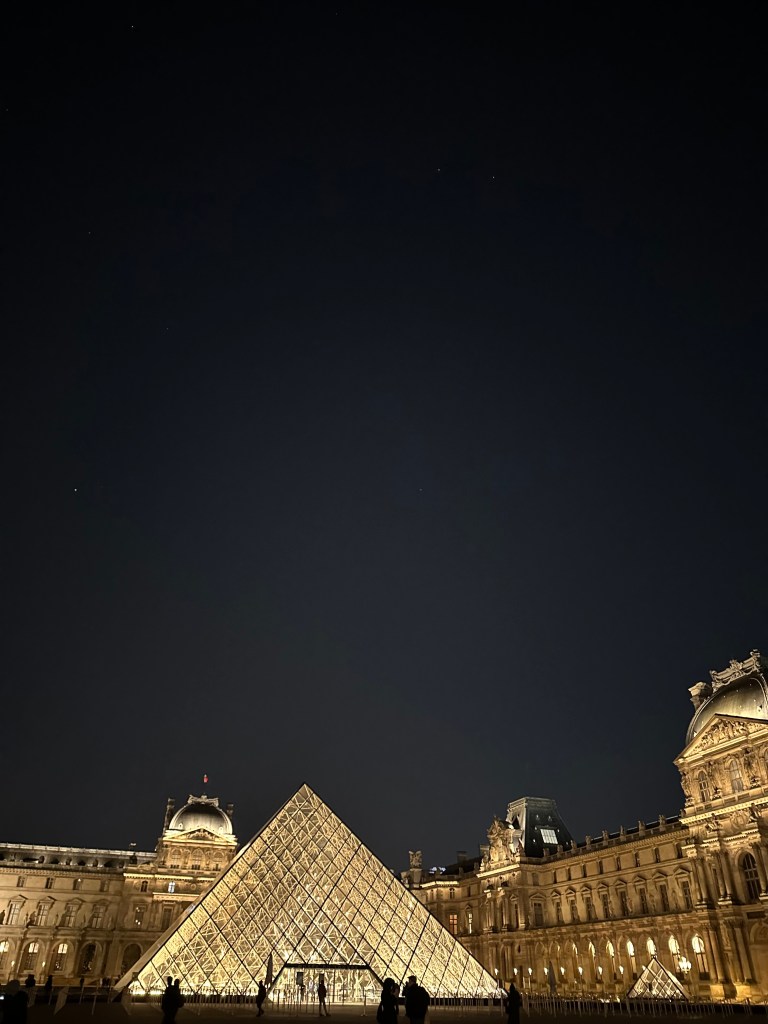
Le Louvre at night: I recently went to the Louvre on a Friday evening (18h30) and it was so much fun. The Louvre is much quieter at night and there were even moments where I was alone in different rooms! It was so cool and made exploring this endless museum all the more exciting.
Speakeasies: Paris has so many hidden bars and speakeasies. While I certainly have not been to them all, two of my favorites are Lavomatic and Candelaria.
Galeries Lafayette rooftop: This is an expensive department store in the 9th arrondissement of Paris. While shopping here is not on my list of affordable activities, going on the rooftop is free and certainly worth the visit!
Brocantes: Paris has so many brocantes, or flea markets, all over the city. Even when not buying or searching for something specific, just browsing through the markets can be such a fun way to spend a few hours while here. The application vide-greniers has a list of upcoming markets or a simple Google search would provide options, too.
Thrift shopping: Especially for younger people, thrift shopping is a great way to find new, affordable clothing items. Le Marais district in Paris has several thrift stores, and sometimes you’ll even find designer pieces!
Luxembourg Gardens / Rue Mouffetard: In the 5th arrondissement you can explore the Luxembourg Gardens (jardin du luxembourg) and even picnic in nice weather. About a 10-minute walk away is one of my favorite streets in Paris, rue Mouffetard, a cute street on a hill filled with places to eat crêpes.
Performances: I’d be remiss if I didn’t mention all of the opportunities there are to see live performances in Paris. The art scene is so vibrant in Paris between the more well-known performances like the Opera to all of the small theatres and venues you can attend for the performing arts. A definite must-do!
Sacre Coeur: This basilica sits on top of the Montmartre hill in Paris in the 18th arrondissement. Climbing up to the top of the hill, not only does Sacre Coeur offer one of the best panoramic views of Paris, but it’s another beautiful church to see on the inside. For 7 euros, you can also climb around 300 steps inside Sacre Coeur to see the view from the very top!
Bateaux Mouches: While in Paris, I would absolutely recommend taking a boat tour of the city, especially at night. This is certainly one of the most touristy things to do in Paris, but worth it to have a different perspective and views from the water.
Eiffel Tower twinkling: The tower twinkles each night starting when it gets dark – every hour on the hour until five past (ex. 21h00 to 21h05)! I believe it stops around midnight. I’ll never get sick of this!
Cabaret in Pigalle: The Pigalle area in the 18th arrondissement of Paris is known for cabarets, particularly the Moulin Rouge. It certainly is a pricey activity, but it’s a show people come to see from across the globe and would definitely make for a fun night out.
Notre Dame: I am so excited to do this. Notre Dame caught fire in 2019 and has just reopened this past week to the public. Tickets are hard to come by, but I’m hoping in the early new year I’ll be able to go!
Seasonal activities-
Summer:
Picnic on champ de mars (behind the Eiffel Tower)
Wine on les quais de la Seine (the platforms along the Seine river)
Musée Rodin – a beautiful museum with a park outside
Parc Monceau – one of the most beautiful parks in Paris!
Parc des Buttes Chaumont – another huge park to visit or picnic at
People watching on a terrace along Canal Saint-Martin – join the Parisian locals along Canal Saint-Martin in spring and summer
Versailles – I’d recommend visiting the Palace of Versailles in the spring or summer because in addition the palace itself, the gardens are so beautiful!
Paris Longchamp – Each spring, the Paris Hippodrome has horse races, on the course called Paris Longchamp. People go to place bets on the horses, and you can find 15 euro tickets to go and watch.
Winter:
Galeries Lafayette glasswalk – Every winter holiday season, the Galeries Lafayette puts up a giant Christmas tree, with a glasswalk out to the tree on an upper level. If you sign up a few days in advance or wait in line on the day of, you can see the tree up close (as long as your not scared of heights!)
Refuge des Fondus or make your own – When in France you have to try cheese, and in the winter having fondu is one of my favorite activities to do with friends. My favorite restaurant for this is Le Refuge des Fondus, a place in the 18th arrondissement. Otherwise, when my mom came to visit we made fondu from home which was also not too hard and very fun.
Lumières en Seine – Just outside of Paris in Saint-Cloud, there is a Christmas light walk that really gets you in the holiday spirit. A great place for photos, I really have enjoyed doing this in the past.
Tuileries Fête Foraine – In the Tuileries garden (jardin des tuileries) there is a festival that happens from November to January each year, filled with rides, food and shopping vendors. While some people avoid this festival due to the crowds, if you find the right times to go it can be a great activity. It’s a great place to try French classic winter foods (raclette, tartiflette, croziflette, aligot, etc.) and of course, the hot wine (vin chaud).
Those are my top 25 – If you’re coming to Paris, let me know if you do any of these recommendations!
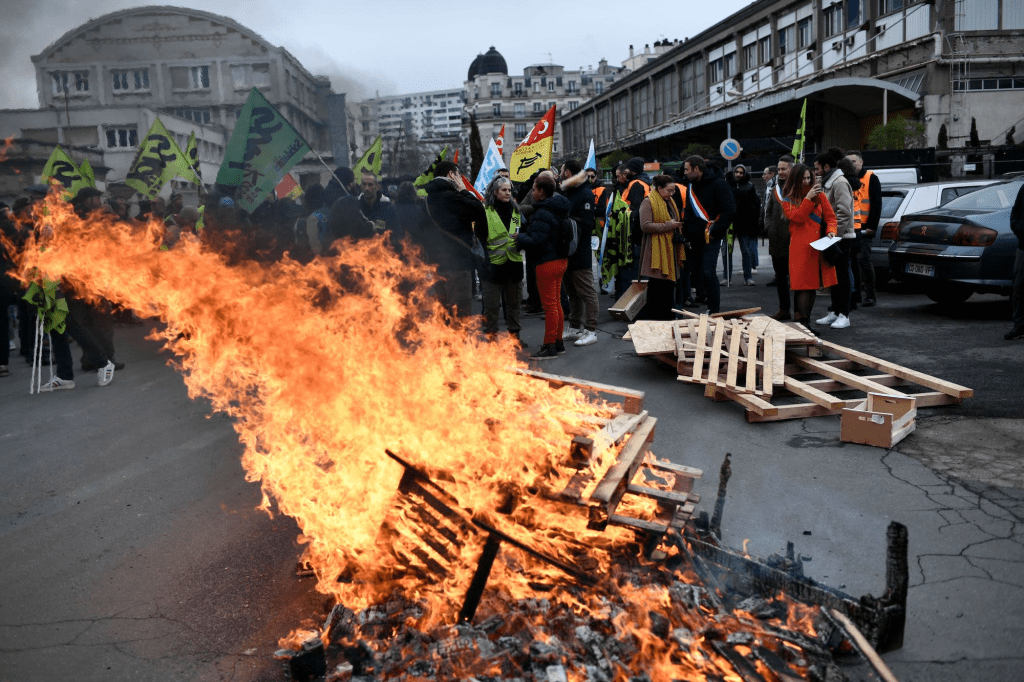
We all remember the political turmoil across France last year after President Emmanuel Macron’s government used Article 49.3 of the French Constitution to bypass a parliamentary vote and pass a controversial pension reform. The law raised the retirement age from 62 to 64 and ignited strong accusations of undemocratic governance, paralyzing the country with strikes and public upheaval. For those who might not remember, here’s a visual reminder:
Image credit: CNN
Well, the lesson has clearly not been learned… France is now thrown yet again into political chaos after a no-confidence vote has left the country with no Prime Minister. Earlier this week, French Prime Minister Michel Barnier used article 49.3 of the Constitution to adopt his financial project for social security, previously failing to win Parliament support to do so. Angering the left party, the Nouveau Front Populaire (NFP), and the right, Rassemblement National (RN), both sides immediately made motions of no-confidence. A vote was held on the motion from the NFP, and a majority 331 votes now forces Michel Barnier to leave his role as Prime Minister.
The first no-confidence collapse since 1962. What does this signify?
Just this past summer, snap elections in France led to no singular party having a majority in the Parliament, causing Macron to nominate Michel Barnier as Prime Minister. Only 3 months later, this no-confidence vote reflects France’s remaining political instability and deepening challenges.
Additionally, it reveals the growing power of the RN, or right-wing party, whose decision to unite with the left in this week’s vote ultimately allowed the no-confidence to succeed. While today no party has the absolute majority in the French Parliament, the RN holding the power as the decision maker in this vote cannot go unnoticed.
What’s the big deal for France and its people?
This vote took place at a time where the Parliament, composed of the Assemblée Nationale and the Sénat, have not yet voted on the country’s budget for 2025.
With less than 25 days to pass the budget before the new year, it would be almost impossible to create a new budget, and without a budget for 2025 the country has no legal authorization to collect taxes from citizens or to finance government spending.
No taxes? A miracle! Yet, as you might suspect, it’s not so simple.
What could happen, instead, is a shutdown of the government, similar to what has happened in the US.
To complicate the situation even more, as per the French Constitution, a new Parliament election cannot happen for at least another 6 months. With no Prime Minister, President Emmanuel Macron (who is rather disliked across the country) is now left to make choices.
Meanwhile, Macron is facing several pushes to step down as President, but this past Thursday evening on live television he declared that he will complete the duration of his term as planned until 2027. However, the timing of this vote could not be worse for Macron, as it puts a damper on the excitement of Notre Dame’s opening weekend, where he was supposed to regain some public appreciation for his commitment to a timely rebuild.
So, what options does Macron have moving forward?
If you’re still following this far, here are 3 possibilities of what may happen next:
Option 1:
Before December 19, a special law can be passed allowing the government to function temporarily using the budget of 2024, transposed to 2025. The problem with this solution is that when doing so, the budget would not account for inflation, while taxes would. This means that taxes would be higher for around 18 million people in France. From my understanding, the special law would have to be adopted and altered to avoid these consequences.
Option 2:
The second option is called les Douzième Provisoires, a provisional budgeting system used when the government cannot pass the annual budget in time. This approach allows for state spending to continue month-by-month at a rate equivalent to 1/12th of the previous year’s budget. In this way, the government is able to maintain essential services while adding stalling time for the new budget negotiations.
While this option could work and may be likely, it is a sign of weakness, indicating profound political struggles within the administration.
Option 3:
A third option would be using article 47 of the Constitution. This would allow the adoption of the budget by ‘ordonnance,’ meaning Macron could sign a text and give himself emergency powers to pass a budget. However, this is highly unlikely because it would be considered anti-democratic, as a means of undermining or diminishing the role of the Parliament. If Macron wants to keep any hope of being even slightly liked by the public, he will not go this route.
What will Macron choose? Only time will tell…
Feel free to leave any questions below and stay tuned for next Saturday’s article!
Summer 2016 feels like just yesterday – the distinct memory of sitting on the beach with my mom wishing I had a French friend to talk with, to practice my (very poor at the time) French language abilities.
Not even a month later, starting junior year of high school, I found myself in study hall each day wondering why this girl was always looking at my French homework. We didn’t speak, but to my luck, this seemingly strange girl joined Dance Club, where I learned that she was French.
We quickly became friends, and from that point on, Marie and I spent every day in study hall together, helping each other with language homework, taking way too many selfies, and exchanging about our cultures. It was one of my favorite periods of the day.
2016 Study Hall
Little did I know, 8 years later, I’d be living in France and going to Marie’s Bachelorette Party and wedding…
EVJF: The French Bachelorette Party
In France, the Bachelorette party is called an EVJF, enterrement de vie de jeune fille, or the ‘burial of the life of the young girl’. A little morbid, no?
What I’ve been told is that Bachelorette parties in general are not super common in France, but that due to the power of social media and the ‘Americanization’ of the concept in France, they are becoming increasingly popular.
Marie had a Bachelorette exactly like I’d imagine they are in the US. Seven other girls and myself traveled to a town called La Baule to surprise Marie with a weekend filled with activities.
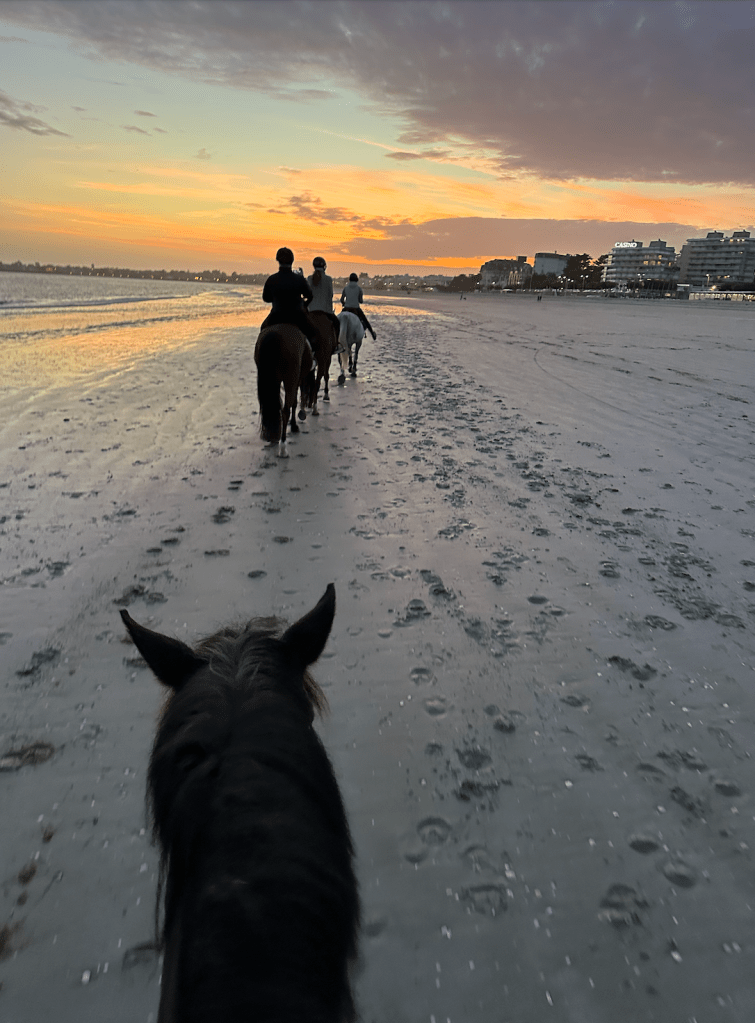
During the 2 days there, we went horseback riding on the beach, tried pole dancing, went to the spa, and ate a lot of good food. It was truly such a fun weekend and it was nice to see all the girls 2 weeks before the wedding. Full French immersion, too!
Wedding Weekend
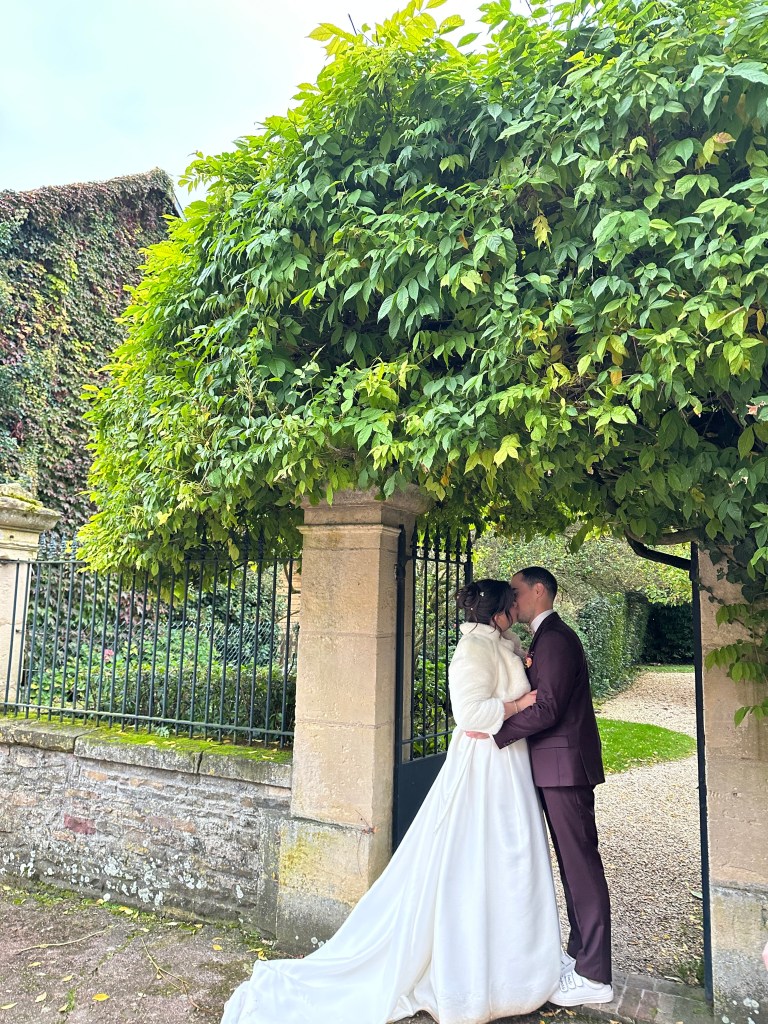
First, let me just say, since this wedding I’m now convinced that when I get married one day it will be French style.
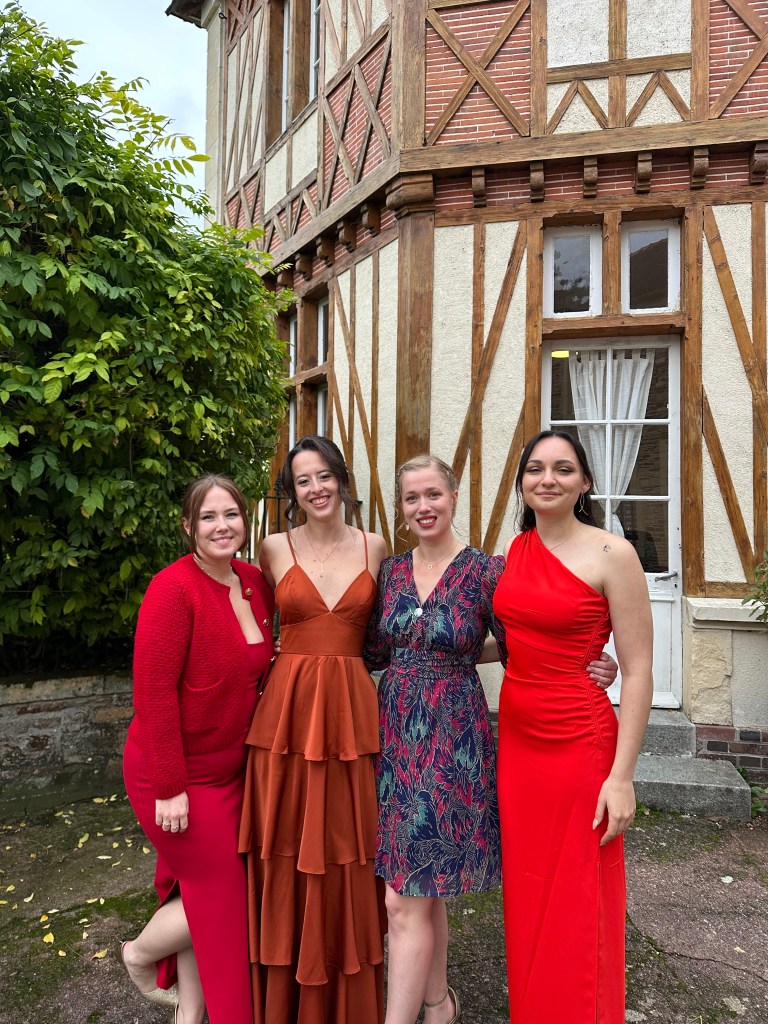
This was my first wedding, and therefore first French wedding, and wow- it was so fun. My day started at 6:30 am with the unlucky spot of first to have my hair done. By 7:30 am I was ready for the wedding, but the festivities didn’t really begin until 1 pm. Around 1:30 the girls who attended the Bachelorette went to Marie’s room for the dress reveal, and of course we all started crying. She was beautiful!
We had the church at 2-4 pm and then what they call vin d’honneur, ‘wine of honor’, which is a reception time between the church and the wedding dinner. Marie really had the best taste, as the food was mini desserts for the first few hours – my dream! Servers would approach with eclairs and cakes, and then as soon as you look the other direction another server was there to fill your other hand. And it was only 6 pm!
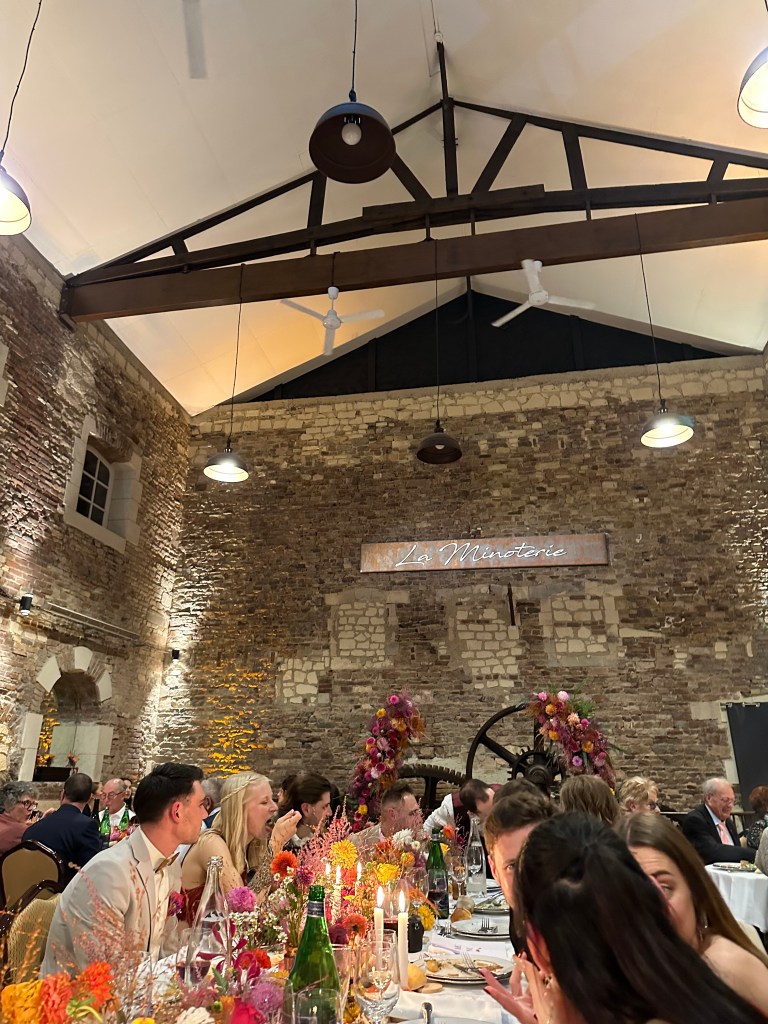
After that, we had a cocktail time, with drinks and salty foods. This lasted from 6:45-8:45 pm, when we eventually sat for dinner. Marie’s family are hospitality professionals, with a Michelin-starred restaurant, so you can only imagine how elevated the food selection was throughout the entire day. Dinner was no different. We had steak and potatoes, with their selected wine pairing and a dessert buffet to conclude the meal around midnight. The dancing began a little after midnight… shocking for my American mind.
It was so special seeing the opening of the ‘bal du mariage’ (dancing), where Marie and her now husband Clément danced to choreography I had done for them. They looked amazing!
Then we danced the night (or morning?) away. It was truly an unforgettable weekend celebrating love!
One of my first memories dealing with the Parisian Metro was when I was visiting with my family in April 2017. We couldn’t navigate very well, and my French proved to be terrible when we arrived (despite thinking otherwise in the U.S.). One day, we were looking to get on the closest Metro, and my parents suggested that I find someone and ask where to find it. So, confidently, I walked up to an older couple and asked “Où est le Métro?” They looked at me so confused, as if I was speaking a different language. I kept saying it over and over again, and finally they started laughing when they knew what I meant. Honestly, pronunciation is still something I need to work on (I cannot make the French R sound for the life of me!)
While we might have just given up on finding it, the Metro is truly one of the best public transportation systems (especially when there are no strikes going on). It is so efficient, quick, and allows you to get practically anywhere in Paris. Paris also has other public transportation systems, including the RER, buses, and trams. While these are also efficient and I did use them frequently, today I wanted to give you a glimpse into the Parisian Metro system, showing some of the stops and where they can take you.
As for what type of Metro card to purchase, I found this article that provides a lot of insight on this subject: https://parisbytrain.com/paris-metro-pass/. It emphasizes the different purchases depending on when you arrive, how long you are staying, and how many times per day you think you will be using the Metro. Personally, when I was going to class and exploring I found myself on the Metro at least three times per day. Yet, it is also dependent on where you are staying and if walking is an option. As seen in the image below, I lived in the 12th arrondissement, so getting to popular tourist spots was nearly impossible by foot. However, if you lived in the 1-7th arrondissements, you may be okay walking to most places and buying individual Metro tickets when needed. For a longer stay in Paris, I’d definitely suggest getting a Navigo pass for whichever duration you choose. During my nearly three-month stay, I had a Navigo pass that refilled each month, which became the most convenient option for this longer-term trip. Again, it really depends on the amount of walking (or other transportation) you want to do during your stay.
There are 14 Metro lines in Paris, but some are definitely more popular than others. In my opinion, Line 1 is the best for getting to the most central tourist spots. With that said, I’ll go over what is found at some of the stops on this line.
Line 1 (created in 1900) takes you across Paris, from the 12th arrondissement to the 16th and beyond. Usually I would transfer from Line 8 (where I started from) to Line 1 at Reuilly-Diderot. From there, I’d continue west on this line. Let’s look closer at the following stops on Line 1:
Gare de Lyon:
This stop is a big transfer spot to RER A and B. It includes TGV trains to southeastern France, Italy, Switzerland, and more.
Bastille:
This metro station is named after the famous Bastille fortress and prison. The fall of Bastille on July 14th, 1789 is now a major holiday in France, representing the fall of the regime and a significant turning point in the French Revolution.
Nearby places to see:
-the Bastille monument
-Opéra Bastille (Opera house)
-MK2 Beaumarchais movie theater
-Le Viaduc Brasserie
-Victor Hugo’s Maison (Victor Hugo’s house)
-Studio Harmonic (closer from Line 8-Ledru Rollin; a dance space similar to
BDC in NY)
-Supersonic (a concert hall)
-Yellow Mad Monkey (an Americanized bar)
-L’Atelier des Lumières (refer to my museum post, about a 20 minute walk from Bastille)
Saint-Paul:
While this stop is somewhat small, it is found in Le Marais, which is a great spot for tourists. This is where I would exit the Metro everyday to go to Micadanses for my dance classes. There is so much to see in Le Marais, and plenty of shopping and food, too!
Places to see:
-Place des Vosges (beautiful park)
-Musée Carnavalet (history museum)
-Musée de la Magie (magic museum)
-Maison Européenne de la Photographie (art museum with contemporary
photography exhibits)
-Picasso Museum
-Princess Crêpe
-Micadanses Studios
-Mémorial de la Shoah (Holocaust Museum)
-Le Caféothèque de Paris (great hot chocolate!)
-Le Peloton Café (also great hot chocolate and bike rentals)
Hôtel de Ville:
This stop brings you to the Hôtel de Ville, which is home to the city’s administration and where the Mayor of Paris resides.
Places to see:
-BHV (Bazar de l’Hôtel de Ville: a huge department store)
-Centre de Yoga du Marais
-Le Centre Pompidou (museum and library)
-Georges (rooftop restaurant of the Pompidou Center-$$$)
-Musée des Arts et Métiers (Museum of Science and Technology)
-Cathédrale Notre Dame (under construction)
-Sainte Chapelle
-Shakespeare and Company (bookstore)
-Pont Neuf (oldest bridge in Paris)
-Musée du Chocolat (Chocolate Museum)
-Lavomatic (a speak-easy style bar)
Châtelet:
This stop is very popular and big, because it has several transfers to other Metro lines and RER trains. It is extremely close to Hôtel de Ville, so the places to see are the same for these two stops!
Louvre-Rivoli:
This stop and the following are good places to get off to see the Louvre 🙂
Palais Royal-Musée du Louvre: the Louvre Museum
Tuileries:
This stop is found by the Jardin des Tuileries. While you could take the Metro here, my suggestion would be to walk from the Louvre to Concorde and not take the Metro to this stop. This will allow you to see the entirety of the gardens. However, as you walk, there are some places to visit nearby:
-Musée d’Orsay
-Angelina Paris (great hot chocolate!)
-Colonne Vendôme
-Palais Garnier (kind of a walk but well worth it; The Paris Opera House)
-Galeries Lafayette (right near Palais Garnier; shopping center with a great ~free~
rooftop view)
Concorde:
This stops at the Place de la Concorde, which is located at the most western end of the Tuileries gardens. The Place de la Concorde has a lot of historical significance, as it was where the guillotine used to be (that executed Marie Antoinette and Louis XVI among many other notable French authorities). There used to be a giant ferris wheel behind the monument that exists here, which juxtaposes fun where so much horror occurred in the past. There are also beautiful water fountains here too. This spot marks one end of the Champs-Élysées.
Places to see:
-Musée de l’Orangerie (houses Monet’s “Water Lilies”)
-Jeu de Paume (contemporary avant-garde museum)
-Ladurée (macarons, anyone?)
-Théâtre de la Ville-Espace Cardin (a beautiful theater)
Champs-Élysées-Clemenceau, Franklin D. Roosevelt, George V
These three consecutive stops are along the Champs-Élysées at various points. While walking this road, I would suggest checking out the Grand Palais and Petit Palais (two museums)
Charles de Gaulle-Étoile:
This stop is the other end of the Champs-Élysées, where the Arc de Triomphe is found. I would definitely recommend stopping here, and if capable doing the trek up the 280-something steps to the top of the Arc. This is one of the best views of Paris, because you can see the Eiffel Tower and the rest of the city.
From the Arc de Triomphe, you can walk to the Eiffel Tower, too! A funny story: When visiting Paris in 2017 with my family, my dad and I navigated from the Eiffel Tower to the Arc, so when I came back to Paris in 2018 to visit my friend Marie, I told her I knew how to get from the Tower to the Arc without directions. I was so confident in my memory that I led the way, and Marie who is not from Paris, trusted my guidance. Three hours later, I decided we should check the map, only to find out we did not make a direct path. The walk between these two monuments should only take 40 minutes… sorry Marie!!
After these stops on Line 1, you start to go to the outskirts of Paris, so I’ll end there. As you can see, Line 1 covers almost all of the major sights for tourists (with a little walking!).
This line doesn’t really cover the left bank (Rive Gauche), as well as northern Paris (Sacre Coeur, Moulin Rouge), etc. For these places you would have to transfer to a different line, but they are fairly easy to get too! Citymapper is a great app to download when traveling to any major city, because it gives step by step instructions for navigation. While traveling is not really happening right now, I hope this is helpful if you visit Paris in the future!
Let me know if you would like to know more about Parisian public transportation:)











 Julia's Journey in Paris
