Participating in a dance program while in Paris, I had the opportunity to see a plethora of performances. Before being sent home, I was able to see twelve performances with my peers in a variety of locations in Paris. Each performance was so unique and unlike anything I’d seen in the U.S.
The origins of dance, specifically ballet, in France are directly correlated to “high culture”. Louis XIV, le Roi Soleil (or Sun King), introduced ballet to the nobility as a way of establishing power. Through his performances, he made it clear that he must be respected and praised, both while dancing and not dancing. He instilled the idea that a sculpted body and daily training were of crucial importance. The better dancer you were, the more power you had amongst the upper class. I’ve written a lot on this subject which I will post soon, as I learned so much valuable and insightful information about Louis XIV and the Baroque era that I’d love to share. However, in this post specifically I’d like to discuss some of the biggest differences in performances that I saw between France and the United States.
Prior to arriving in Paris and having the opportunity to ask my dance professors questions and see performances, I had a false preconception of what the dance scene was like in France. Even though I had been to Paris twice before, I had never seen dance there, which allowed me to continue to unknowingly be ignorant on this subject until my spring 2020 semester. I somehow thought that dance was less popular abroad, and therefore it’s easier to get a job. I knew that the government supports the arts more than in the United States, but I didn’t know much about that, either. After just a few weeks in Paris, and asking a lot of questions, I believe that now I have a deeper understanding of the arts abroad.
The government does provide grants for the arts much more so than in the U.S., yet getting one is definitely not easy, as there are so many other artists competing for the same pool of money that you are. One of my professors, Wanjiru Kamuyu, corrected me on some of my misconceptions after a World Dance class in January. As a choreographer and dancer, and a now solo artist, she elaborated on the challenges of acquiring money to create work. Without going into too much detail, I know that there was an extensive amount of work that went into submitting a proposal for her grant.
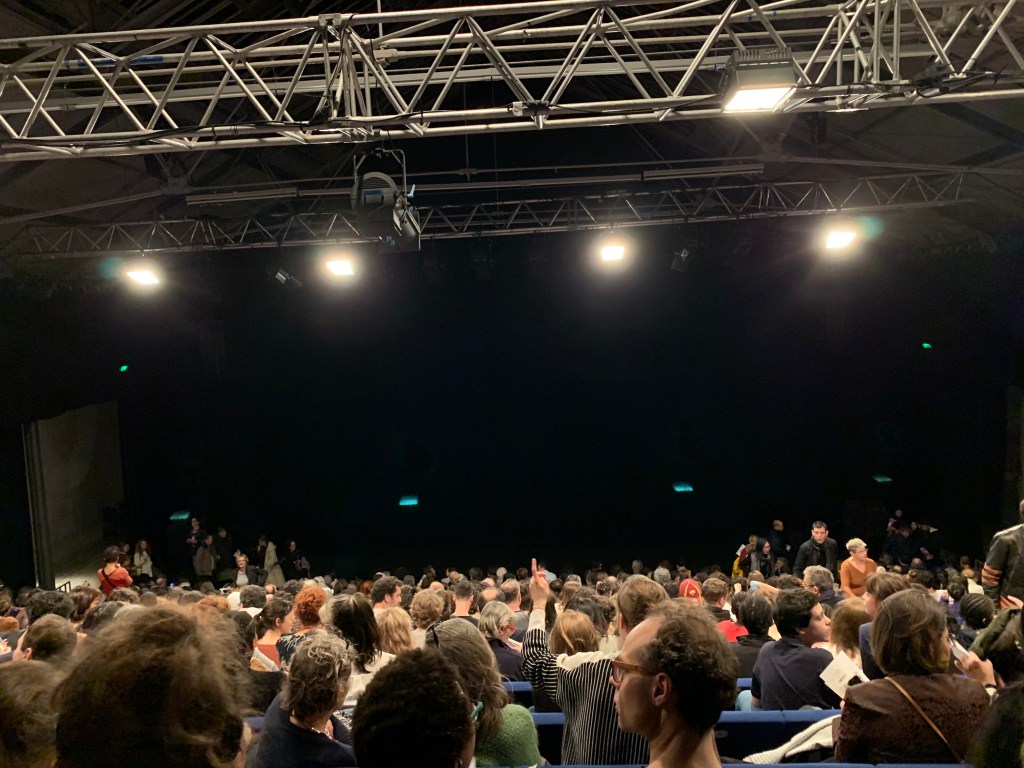
However, for companies and artists that have earned some money, they have the ability to create more of a “production”. By this, I mean that there were often more props, staging, costuming, and elements that often made the dance performances feel more closely tied to theatrical performances. Props and sets that I couldn’t even have imagined before Paris seemed commonplace. I will insert pictures/video links below that illustrate this point. With more funding in the U.S. for the arts, potentially we could bring in elaborate performances like the ones that I saw abroad. And I don’t mean to say that it has never been done in the U.S., but I would argue that it is much more rare.
These performances also made me reevaluate my understanding of what can be defined as dance. Previously, I had been used to seeing technical movements in pieces, and going into an American “modern dance” performance, I had an idea of what I would be watching that night. In Paris, with such extravagant performances, I really had no clue what each show would bring. Some of the performances didn’t even include a single movement that I could name with a dancer’s vocabulary. This made me think: What qualifies a work as a dance performance, or modern dance? And to be honest, I still am not sure I could completely answer this in a sentence or two. But, it surely is a question to think about and investigate with every dance piece that we see as artists.
Despite the shows that seemed to require lots of money to enhance the production, performances were fairly inexpensive abroad. The tickets usually ranged from 10 to 30 euros, which is nearly the same in dollars. Personally, I found this to be less expensive than seeing companies in the U.S. If I were to go see a modern performance in America, I would probably pay anywhere between $25 to $50. Not that the disparity here is crazy, but there is definitely a slight lowering of prices in Paris. The only place I did not notice a lowering of price was at the ballet. When I saw the Paris Opera Ballet, my ticket was relatively inexpensive, but I was sitting in the epitome of a nose-bleed seat. If you were to buy a ticket closer up, it would likely cost about the same as paying full price at ABT or the NYCB performances. The Paris Opera Ballet is the oldest ballet company and very well-known, so maybe this has something to do with the higher prices, but that is just a guess.
Other differences I noticed in performances abroad were with the audience. In America, if you do not enjoy a performance, you sit through it anyways, and then reveal your dislike with friends and family afterwards. In Paris, if you do not like a work that you are seeing, you can leave. At a few of the works I saw, audience members would quietly stand up and exit the theater. It did not seem rude or bizarre to the crowd. This seems to be a different custom, and it may correlate to the inexpensive nature of the works, as people are more apt to leave not having spent a large sum of money. Further, the shows were almost always sold out, which, especially in the dance scene of New Hampshire, never happens. The members of the audience came from such diverse populations. I believe there is a stereotype to who attends performances in the U.S., and dance performances have less traction unless it appeals to the entertainment audience of commercial dance. In Paris, these stereotypes were completely nonexistent. Young and old, dancers and non-dancers, men and women, all of these crowds attended the performances that I saw. It was great to see such sincere interest and excitement for dance. And this excitement was especially noted in the applause that followed each performance.
Applause in the U.S. in my own experience seems to last for about a minute; it really feels very short. Since attending Hofstra and seeing several performances in NYC each semester, I noted that applause at the ballet (both ABT and NYCB) lasts much longer than other shows in America. Yet, nothing prepared me for the applause in Paris. Applause lasted for what felt like an eternity, but was probably more like five minutes. For an audience member, that is a long time compared to what we grow up with. I even recorded the applause when I went to the Palais Garnier to see the Paris Opera perform Giselle, and it was six minutes!! Six minutes seems short, but try clapping that long and let me know when your hands start to tingle! The applause signals that the dancers should come out to bow again, so as long as the clapping continues, the company will continue to leave and return to the stage for several bows. Sometimes, it became slightly comedic seeing the dancers take the stage for their 10th bow, but it truly signifies the respect that the audience holds for the performance they saw.
Respect for dance is something that I definitely felt to be stronger while abroad. I think many American dancers feel that when someone asks you what you want to be, and you reply with “a dancer”, it often comes with a follow-up question of: “And what else? How will you make money?” While yes, there is less money in this industry, dance is sort of regarded in a lesser way in the U.S. From my impressions in Paris, dance is a legitimate career path that is more well-respected. With that said, it is interesting that higher education in France does not offer many dance programs. There are a very limited number of places to study dance, one of which, the Centre International de Danse, I had the opportunity to visit thanks to Hofstra faculty member Dyane Harvey-Salaam. Stay tuned for my next post all about this visit!
Performances of my semester in Paris, France:
1)Yoann Bourgeois “Celui Qui Tombe”
Thurs, Jan 9, 8:30
5 Rue Curial, 75019
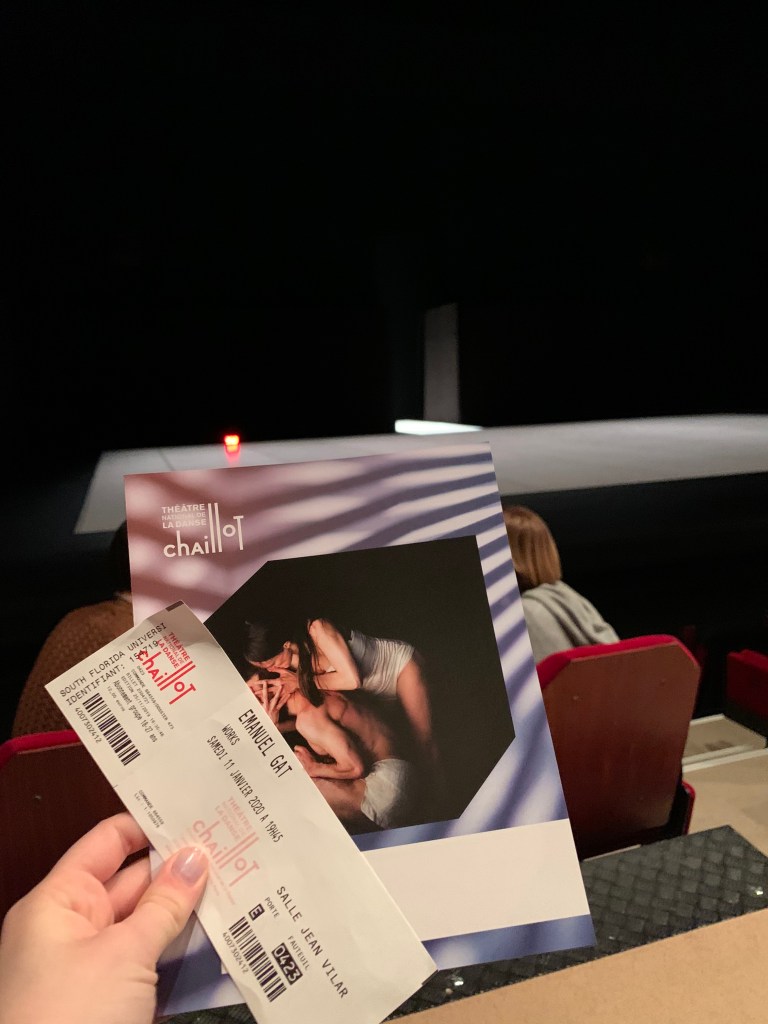
2)Emanuel Gat “Works”
Sat, Jan 11, 7:45
1 Place du Trocadéro, 75016
3)Nathalie Pubelier’s “Non, pas toi!”
Monday, Jan 20, 8:30
8-12 rue Bertin-Poirée, 75001
(No video, but she was my choreography teacher in Paris!)
4)Wendy Whelan and Lucinda Childs “The Day”
Sat, Jan 25, 8:00
Théatre de la Ville, 2 Place du Châtelet, 75004
5)Peeping Tom’s “Kind” (Child)
Wednesday, Jan 24, 8:00
1 Place Salvador Allende, 94000, Creteil, France
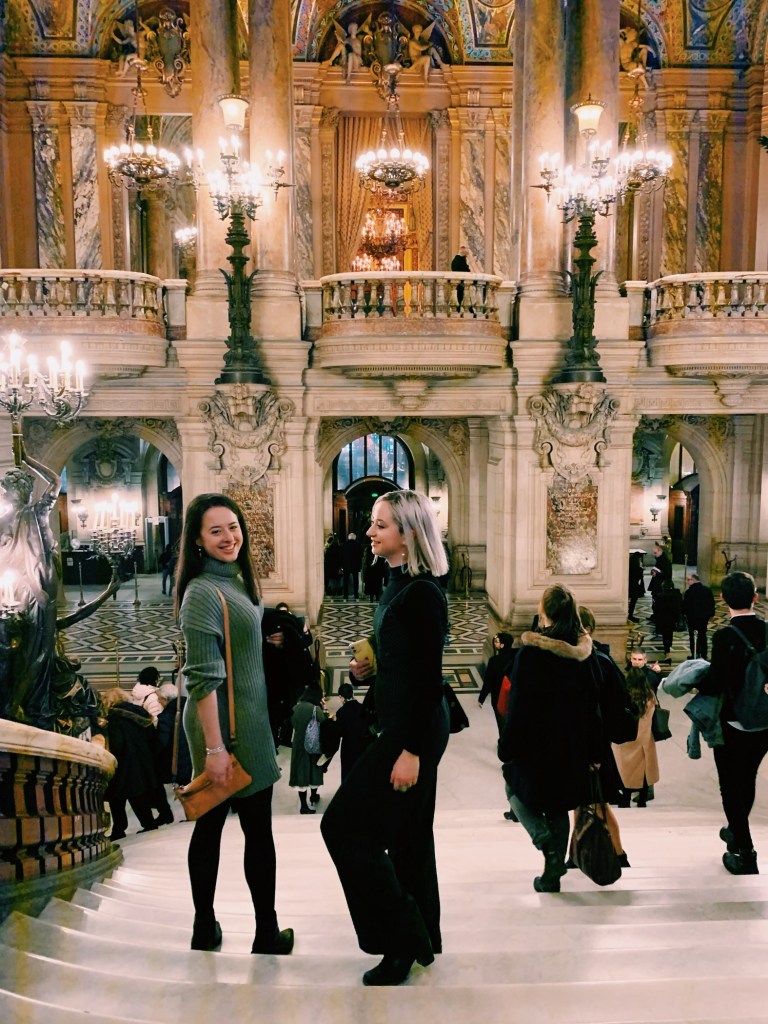
6)Paris Opera Ballet Giselle
Sunday, February 2nd, 8:00
Palais Garnier
https://www.youtube.com/watch?v=3tOziQuNKPg (A video on the Paris Opera).

Processed with VSCO with c1 preset
7)Eva Yerbabuena’s “Cuentos de Azúcar”
Wednesday, February 5 8:30-10
Théâtre National de Chaillot, 1 Place du Trocadéro 75016

8)Anne Teresa de Keersmaeker’s Fase
Wed, February 19, 8:00
Théâtre de la Ville, 75008 Paris
(I’ve written a bit about this show that I will post soon and link here!)
9)Christos Papadopoulus Elvedon Ion
Saturday, February 22nd, 5:00
31 Rue des Abbesses, Montmartre, 75018 Paris
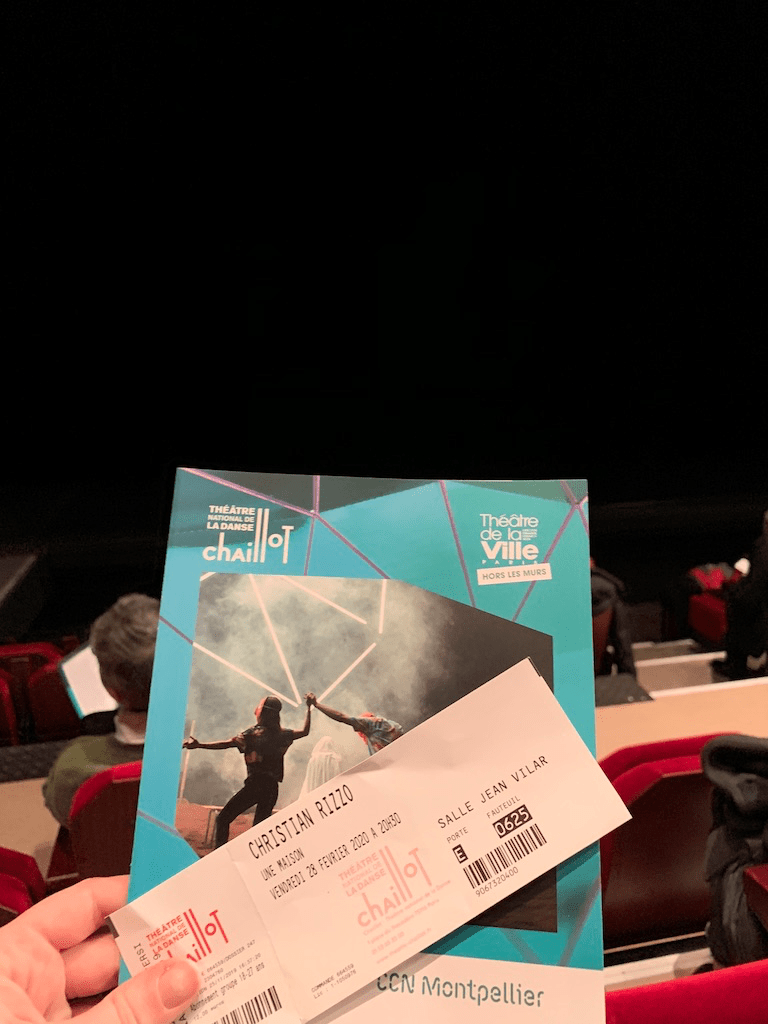
10)Christian Rizzo Une Maison
Friday, February 28nd, 8:30
Théâtre National de Chaillot, 1 Place du Trocadéro 75016

11)Damien Jalet and Kohei Nawa Vessel
Wednesday, March 11 9-10
Théâtre National de Chaillot, 1 Place du Trocadéro 75016

12)Moulin Rouge

 Julia's Journey in Paris
You are a gifted writer with great experiences to write about.
LikeLike