We all remember the political turmoil across France last year after President Emmanuel Macron’s government used Article 49.3 of the French Constitution to bypass a parliamentary vote and pass a controversial pension reform. The law raised the retirement age from 62 to 64 and ignited strong accusations of undemocratic governance, paralyzing the country with strikes and public upheaval. For those who might not remember, here’s a visual reminder:
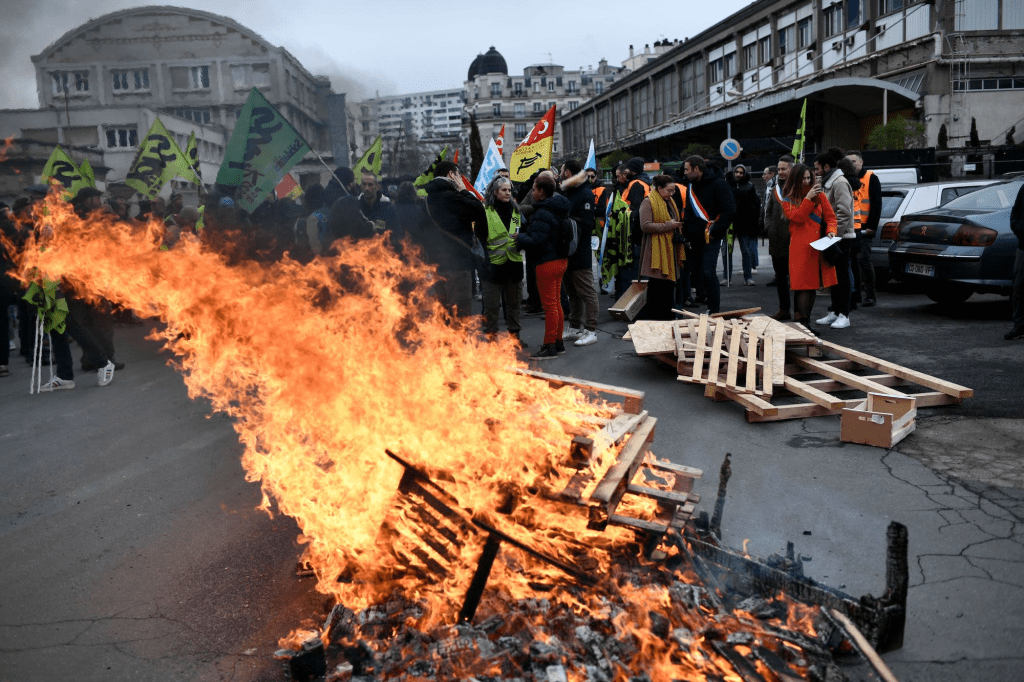
Well, the lesson has clearly not been learned… France is now thrown yet again into political chaos after a no-confidence vote has left the country with no Prime Minister. Earlier this week, French Prime Minister Michel Barnier used article 49.3 of the Constitution to adopt his financial project for social security, previously failing to win Parliament support to do so. Angering the left party, the Nouveau Front Populaire (NFP), and the right, Rassemblement National (RN), both sides immediately made motions of no-confidence. A vote was held on the motion from the NFP, and a majority 331 votes now forces Michel Barnier to leave his role as Prime Minister.
The first no-confidence collapse since 1962. What does this signify?
Just this past summer, snap elections in France led to no singular party having a majority in the Parliament, causing Macron to nominate Michel Barnier as Prime Minister. Only 3 months later, this no-confidence vote reflects France’s remaining political instability and deepening challenges.
Additionally, it reveals the growing power of the RN, or right-wing party, whose decision to unite with the left in this week’s vote ultimately allowed the no-confidence to succeed. While today no party has the absolute majority in the French Parliament, the RN holding the power as the decision maker in this vote cannot go unnoticed.
What’s the big deal for France and its people?
This vote took place at a time where the Parliament, composed of the Assemblée Nationale and the Sénat, have not yet voted on the country’s budget for 2025.
With less than 25 days to pass the budget before the new year, it would be almost impossible to create a new budget, and without a budget for 2025 the country has no legal authorization to collect taxes from citizens or to finance government spending.
No taxes? A miracle! Yet, as you might suspect, it’s not so simple.
What could happen, instead, is a shutdown of the government, similar to what has happened in the US.
To complicate the situation even more, as per the French Constitution, a new Parliament election cannot happen for at least another 6 months. With no Prime Minister, President Emmanuel Macron (who is rather disliked across the country) is now left to make choices.
Meanwhile, Macron is facing several pushes to step down as President, but this past Thursday evening on live television he declared that he will complete the duration of his term as planned until 2027. However, the timing of this vote could not be worse for Macron, as it puts a damper on the excitement of Notre Dame’s opening weekend, where he was supposed to regain some public appreciation for his commitment to a timely rebuild.
So, what options does Macron have moving forward?
If you’re still following this far, here are 3 possibilities of what may happen next:
Option 1:
Before December 19, a special law can be passed allowing the government to function temporarily using the budget of 2024, transposed to 2025. The problem with this solution is that when doing so, the budget would not account for inflation, while taxes would. This means that taxes would be higher for around 18 million people in France. From my understanding, the special law would have to be adopted and altered to avoid these consequences.
Option 2:
The second option is called les Douzième Provisoires, a provisional budgeting system used when the government cannot pass the annual budget in time. This approach allows for state spending to continue month-by-month at a rate equivalent to 1/12th of the previous year’s budget. In this way, the government is able to maintain essential services while adding stalling time for the new budget negotiations.
While this option could work and may be likely, it is a sign of weakness, indicating profound political struggles within the administration.
Option 3:
A third option would be using article 47 of the Constitution. This would allow the adoption of the budget by ‘ordonnance,’ meaning Macron could sign a text and give himself emergency powers to pass a budget. However, this is highly unlikely because it would be considered anti-democratic, as a means of undermining or diminishing the role of the Parliament. If Macron wants to keep any hope of being even slightly liked by the public, he will not go this route.
What will Macron choose? Only time will tell…
Feel free to leave any questions below and stay tuned for next Saturday’s article!
 Julia's Journey in Paris
Wow! Julia a lot going on in France.
LikeLiked by 1 person
Yes! I’ll do an update soon!
LikeLike